
Short version: When an EV won’t unlock or wake up, it’s almost always the small 12V battery, not the expensive high-voltage traction pack. The 12V boots the computers and closes the contactors that connect the big pack — when it’s flat, nothing else can happen. Get in with the mechanical key hidden in your fob, jump it at the correct point for your model, and let the car recharge it in Ready for 30 to 60 minutes.
You walk up to your Leaf, or your Bolt, or your Tesla. It won’t unlock. Or it unlocks but won’t wake up — you sit down, press the brake, and nothing happens. Maybe the dash flickers a wall of warning lights, or a message pops up and dies. The car is dead in a way that feels catastrophic, and the first thing that goes through your head is the one number every EV owner dreads: the cost of a new traction battery.
Stop. Take a breath. Nine times out of ten this isn’t the big expensive battery at all. It’s the little 12V battery — the same cheap part that strands hybrids — and on an EV it can act even scarier, because a dead 12V can lock you out of your own car.
Yes, your EV has a 12V battery — and it does the humble job
Almost every EV on the road still has a small 12V battery tucked under the hood or in the cargo area, right alongside the giant high-voltage traction pack that actually moves the car. People are surprised by this. Why would an electric car need an old-fashioned 12V battery?
Because something has to wake the car up first. The 12V battery has one job: boot the computers and close the big relays — called contactors — that connect the high-voltage pack to the rest of the car. Until those contactors close, that traction pack is just sitting there, disconnected and useless. No 12V, no wake-up, no contactors, no car. It doesn’t matter that your traction pack is charged to 90% — if the 12V is flat, nothing happens.
Once the car is awake and in Ready, a device called the DC/DC converter takes over. It’s the EV’s version of an alternator: it taps the high-voltage pack and steps that down to about 13–14 volts to run the car’s electronics and keep the 12V battery topped up. So while you’re driving, or just sitting in Ready, the little battery is being charged. Switch the car off, and on most EVs the DC/DC converter stops — and the 12V is on its own. That’s the whole story, and it’s the same story as a Prius. The 12V is small, it boots the system, then it hands off.
When the 12V dies, an EV can lock you out
Here’s where an EV gets meaner than a hybrid. On a Prius with a dead 12V you can still open the door with the key and pop the hood. On a lot of EVs, a flat 12V takes the doors, the charge-port door, and even the hood release down with it. In our shop the pattern looks like this:
- It won’t unlock. You press the fob and nothing happens. The door handles are dead.
- It won’t go to Ready. You get in, press the brake, and the car just won’t come alive.
- The warning lights flicker. A weak-but-not-dead 12V gives you a dashboard that stutters and flashes — lights coming and going, messages that appear and vanish. It looks possessed.
- The charge-port door won’t open, so you can’t even plug in to try to “charge your way out of it.”
- On a Tesla, you get a low-voltage warning on the screen — and then, if it goes fully flat, a car that won’t open its own frunk to let you reach the battery.
Every one of these looks like a total system failure. Almost none of them are. They’re a small, cheap battery that ran down and left the computers seeing voltage too low to function — scared and confused, the same as a hybrid. Restore good 12V voltage and the gremlins clear.
How EV 12V batteries die
A few causes come up again and again:
The DC/DC converter only charges the 12V when the car is awake or actively charging. Park the car and, on most EVs, that top-up stops. The car is supposed to wake itself periodically to keep the 12V alive — but some do this poorly.
The Leaf and the Bolt are the two we see run their 12V down most often. Both have a reputation for a flat 12V after they’ve sat. Parked and switched off, their DC/DC converter mostly isn’t running, so the 12V just sits there slowly self-discharging — the Leaf tops it up only briefly and infrequently, and the Bolt only checks it on an interval. Park either one during the week and coming back to a dead 12V isn’t unusual.
A Tesla manages this differently — and better, when it’s left alone. Instead of letting the little battery sit, the car keeps an eye on it and, when it runs low, briefly wakes itself, reconnects the high-voltage pack, runs the DC/DC converter to top the 12V back up, then goes back to sleep — all on its own, no plugging in required. (Despite what you’ll often hear, a parked Tesla doesn’t just hold the high-voltage pack connected the whole time; it reconnects in short bursts, only as needed.) That automatic upkeep is why a Tesla’s low-voltage battery usually stays healthy sitting in a driveway — and part of why the car quietly loses a little range every day just parked. What defeats it is anything that keeps the car awake around the clock — which brings us to the next culprit.
Tesla Sentry Mode and the cabin cameras. Sentry keeps the cameras and computer powered and recording while the car is parked. Tesla’s own manual warns that “power consumption may increase” with Sentry on, and owners commonly measure it pulling roughly a mile of range an hour. Leave it armed in a parking garage all day, every day, and you’re draining the car around the clock.
Aftermarket gadgets that never sleep. A hardwired dashcam, a cheap OBD-II dongle left plugged into the diagnostic port, a phone charger wired to always-on power — any of these can keep the car awake or quietly bleed the 12V down over days. On Teslas specifically, a dongle in the port is a well-documented way to stop the car from sleeping.
Long storage and vacations. Park any EV at the airport for two weeks and the 12V can be flat when you get back, even with a full traction pack. The always-listening keyless system, the connected-car modules, and a pending software update the car is waiting to install all nibble at the battery the whole time you’re gone.
Getting into a locked-out EV — and jumping it right
First, the way in. Almost every EV fob hides a mechanical key — slide off the back of the fob and there’s a metal blade that opens the driver’s door the old-fashioned way. That’s your route in when the buttons are dead. From inside, you can reach whatever the car needs next.
After that, do not guess at the jump point. This is the one place where EVs differ wildly, and clamping onto the wrong thing can cost you real money. Here’s what we see on the cars that come through our shop:
- Nissan Leaf — the 12V battery is right under the hood at the front, and you jump directly at it: red to the positive post, black to a clean metal ground away from the battery. Pop the hood with the interior release, and it’s a conventional-looking battery.
- Chevy Bolt — you don’t clamp the buried battery. There’s a remote positive post under a small lid in the underhood fuse block, marked with a red “+,” and a ground stud nearby. That’s your jump point.
- Chevy Volt — this one fools people. The actual 12V battery lives in the rear cargo area under the load floor, but you jump the car at the under-hood remote terminals — a positive post and a stud plainly marked “GROUND.” Use those, not the rear battery, to wake your own car.
- Tesla — special case. With a fully dead low-voltage battery you can’t even open the frunk. You pop the front tow-eye cover and there are two small wires, red and black; feeding 12V there only releases the hood latch — it does not charge the battery. Once the frunk is open you get to the actual low-voltage battery. Doors use a manual release from inside.
- Hyundai Ioniq hybrid — there isn’t a separate 12V battery to clamp. It’s built into the hybrid battery assembly, and the car has a 12V reset switch on the lower dash that commands it to reconnect and recharge itself.
For the full step-by-step on a Toyota hybrid — which shares the “wake it and let the DC/DC take over” logic — see our guide: How to Jump Start a Prius. And the companion to this article covers the same 12V story on the hybrid side: Why Your Prius or Toyota Hybrid Won’t Start: The 12V Battery Explained.
Two good walk-throughs on video, if you want to watch it done:
And the rule that catches people: never use your EV to jump-start another vehicle. That small 12V and the DC/DC converter behind it were never built to dump the hundreds of amps a dead gas truck’s starter demands. You can cook the converter — a far more expensive repair than a jump box. Your EV is not a jump pack.
Keep a jump box in the trunk — the NOCO GB40
Skip the jumper cables and the flag-down-a-stranger routine. We tell every EV and hybrid owner to keep a small lithium jump box in the car. The NOCO GB40 is a solid, well-priced choice — small enough to live in the trunk, and it’ll wake a dead 12V without needing another car. (Heads up: that’s an affiliate link — if you buy through it, Atomic Auto may earn a small commission at no extra cost to you.) Charge it a couple times a year and it’s there when you need it.
Part of why we like it: it’s a smart jump box. It checks the connection before it sends any power, so if you clamp the leads backward it simply won’t turn on instead of throwing sparks. For most dead-12V situations you clamp it on, it confirms a good connection, and you’re back in business in seconds.
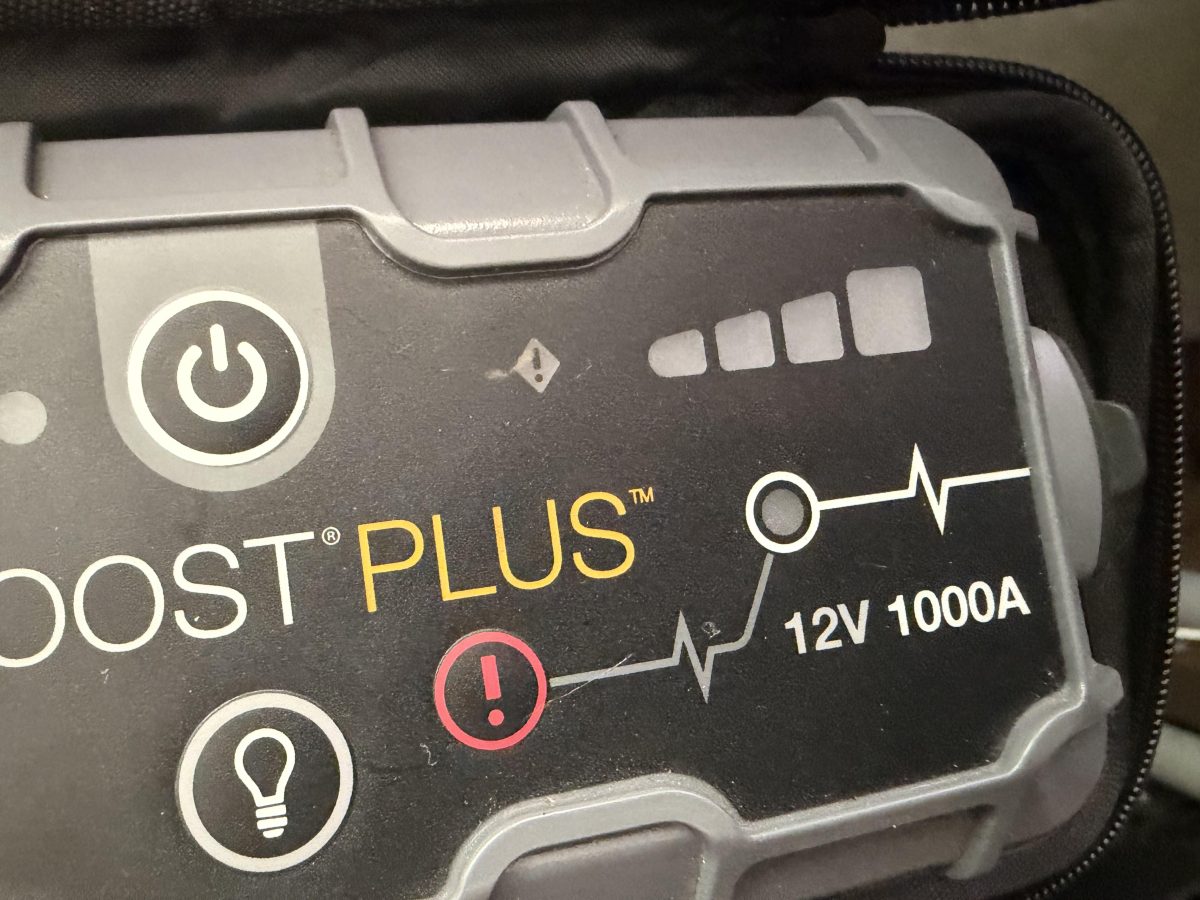
One important exception — a fully dead battery and “Manual Override.” The GB40 only auto-detects and boosts a battery down to about 2 volts. If your 12V is completely flat, the boost light stays off because the box can’t “see” a battery. To force it, use the GB40’s Manual Override button — the one marked with a red exclamation point (!) — and hold it about 3 seconds until the charge lights start chasing.
Here’s the catch: Manual Override turns off all the safety features — both the spark protection and the reverse-polarity protection. In that mode, if your clamps are backward, nothing stops it. So before you use it: double-check red is on positive and black is on ground, connect carefully, and turn the jump box off before you remove the clamps. Used right it revives a stone-dead battery; used carelessly it can spark or damage the car. When in doubt, that’s a good moment to call us.
(One extra note for Tesla owners: newer Model 3, Y, S, and X use a lithium low-voltage battery — often called the “16V” — instead of a normal 12V. You can still wake the car at the tow-eye terminals with a normal 12V jump box, but you cannot buy an off-the-shelf charger to maintain that lithium pack the way you would a lead-acid battery. If a newer Tesla keeps killing its low-voltage battery, that’s a conversation to have with a shop, not a trickle charger.)
After a jump, recharge it right — and know when it’s toast
A jump only wakes the car. It does not refill the battery. Two things bite people here.
Leave it running long enough to recharge. Once the car is in Ready, the DC/DC converter charges the 12V from the traction pack — and just like a hybrid, sitting parked in Ready charges it as well as driving does. Plan on 30 to 60 minutes, and switch off the loads you can — climate, lights, heated seats — so more of that current goes to the battery. Hyundai spells it out for their EVs: 30 minutes minimum, up to 60 if it was completely flat.
Don’t count on “just plug it in” — it’s model-dependent. This trips people up. On a Tesla, plugging in (and even just parking) does keep the low-voltage battery maintained, because the car wakes itself to top it off. On a Leaf, Bolt, or Volt, the 12V mostly only charges while the traction pack is actively charging — once the car finishes charging or just sits plugged in, that 12V top-up can stop. On a Leaf, leaving it plugged in after the charge completes can actually let the 12V drain. So plugging in is not a reliable way to rescue a dead 12V on those cars.
Know when the battery is done. A 12V that sat stone dead for days is often damaged — deeply discharging a lead-acid battery permanently costs it capacity. If yours needed a jump and it’s not the first time, it’s probably worn out and will keep stranding you until it’s replaced. And if you keep killing a healthy 12V, the real problem may be the DC/DC converter not doing its job — that’s worth testing, not ignoring.
And know what you’re replacing it with — the 12V isn’t always a plain lead-acid battery anymore. The industry is steadily moving off the old flooded lead-acid battery. A lot of EVs and hybrids now ship with an AGM battery — still lead-acid, but sealed, more vibration-resistant, and far more tolerant of being run down and cycled — and a growing number, including Tesla’s newer Model 3, Y, S, and X, have switched to a lithium low-voltage battery outright. Two things follow from that. First, replace like with like: if the car came with AGM, don’t drop in a cheap flooded battery — the charging system and the mounting were designed around AGM, and the wrong type dies early or throws faults. Second, a lithium battery needs a lithium charger. A normal lead-acid trickle charger or maintainer uses the wrong charging profile and can refuse to charge a lithium battery or damage it — and Tesla’s lithium low-voltage pack has no off-the-shelf maintainer at all; the car is designed to look after it. A jump box like the NOCO GB40 is still fine to wake any of these — flooded, AGM, or lithium — because you’re only booting the car so its own converter can take over, not charging the battery. But when it’s time to actually replace or maintain one, the chemistry matters, and it’s an easy thing to get wrong. Not sure what your car takes? Ask us.
“I put in a new 12V but it still acts weird”
We hear this one a lot, and it’s usually not the battery — it’s how it went in. Three connections have to be right: the positive terminal, the negative terminal, and the ground that bolts to the body. Any one of them loose, corroded, or bolted to paint instead of clean metal leaves the computers seeing weak, noisy voltage — and the car throws odd warnings, drops accessories, or won’t wake, even with a brand-new battery in it. If your gremlins showed up right after a battery swap, start there before chasing anything expensive.
Make your 12V last
There’s no fixed replacement interval — it depends on the car and how it’s used. A few habits stretch it, and they differ by model:
- Drive it, or maintain it. An EV that sits for weeks will slowly flatten its 12V. If it’s going to sit, the reliable fix on a Leaf, Bolt, or Volt is a proper 12V battery maintainer clamped to the battery. For storage over about a month, GM’s guidance for the Bolt and Volt is to leave the car unplugged with the traction pack around 30%, and either disconnect the negative terminal or put it on an AGM-compatible tender.
- On a Leaf, don’t just leave it plugged in and walk away expecting the 12V to stay healthy — it won’t once the charge completes. A maintainer on the 12V is the answer.
- On a Tesla, the opposite: keep it plugged in during long parking, turn on Low Power Mode, and switch Sentry Mode off when it’s parked somewhere safe. Those three do most of the work.
- On an Ioniq 5, use Utility Mode when you’re parked and running accessories — it draws from the high-voltage pack instead of the 12V — and let the Aux Battery Saver do its job.
- Pull the parasites. Unplug OBD dongles when you’re not using them, and make sure a hardwired dashcam has an auto-shutoff so it isn’t running all night.
How we catch a weak 12V before it strands you
When we’ve got an EV in for service, testing the 12V is part of the job — same as we do on every hybrid. A weak battery shows its hand on a test bench long before it leaves you stuck in a parking lot, so catching it on a regular visit is the easiest way to skip the whole ordeal.
This article is here mostly so you understand what’s happening under the hood — so the next time your EV won’t wake up and your stomach drops, you’ll know the smart money is on the cheap battery, not the expensive one. If you’re in the Portland area and you’re stuck, or you just want the 12V checked before a road trip or a stretch of sitting, come see us. We’ll test it first.
Frequently asked questions
My EV is completely dead. Does that mean the expensive battery failed?
Almost never. A dead 12V battery makes the whole car act broken — no unlock, no Ready, flickering lights — even though the high-voltage traction pack is fine. The 12V just wakes the car up; when it’s flat, nothing else can happen. It’s usually the cheapest battery in the car, not the most expensive one.
Why won’t my EV unlock or open the charge port when the 12V is dead?
Because the 12V powers the door locks, the charge-port door, and the computers. When it’s flat, those all go dead too. Use the mechanical key hidden in your fob to get into the driver’s door, then deal with the battery from there. On a Tesla, a fully dead low-voltage battery even locks the frunk until you feed power to the tow-eye terminals.
Can I recharge my EV’s 12V just by plugging the car in?
It depends on the car. A Tesla keeps its low-voltage battery topped off while plugged in and parked. A Leaf, Bolt, or Volt generally only charges the 12V while the traction pack is actively charging, so “just plug it in” is not a reliable fix on those — and on a Leaf, leaving it plugged in after charging finishes can even drain the 12V. After a jump, leave the car in Ready for 30 to 60 minutes instead.
Can I use my EV to jump-start another car?
No. The 12V battery and the DC/DC converter behind it were never designed to deliver the huge current a gas engine’s starter needs. You risk damaging the converter, which is a far more expensive repair than a jump box. Use a proper lithium jump box like a NOCO GB40 instead.
Why does my Leaf (or Bolt) keep killing its 12V battery?
Both are prone to it when they sit. Their systems only top up the 12V under certain conditions, so a car parked for days can run its 12V down. If yours dies repeatedly, the battery itself is probably worn out and due for replacement — and if a new one keeps dying too, the DC/DC converter or a parasitic drain is worth testing.
Does Tesla Sentry Mode drain the battery?
Yes. Sentry keeps the cameras and computer awake and recording, and Tesla’s own manual notes it increases power use — commonly around a mile of range an hour. It draws from the traction pack, but leaving it armed constantly is a common reason a Tesla runs its charge down faster than expected. Turn it off when the car’s parked somewhere safe.
Related reading
- Why Your Prius or Toyota Hybrid Won’t Start: The 12V Battery Explained
- How to Jump Start a Prius (Step-by-Step, All Generations)
- Nissan Leaf Won’t Charge? It Might Be the PDM (Power Delivery Module)
- Buying a Used Nissan Leaf: What Our Shop Has Seen (And What the Seller Won’t Tell You)
Hero photo: second-generation Nissan Leaf by 4300streetcar, licensed under CC BY 4.0, via Wikimedia Commons.
Questions about your car? Text us at 503-969-3134 — it’s the fastest way to reach us.
About the author: Travis Decker is the owner of Atomic Auto in Portland, Oregon, and an ASE Master Technician (L1, L3). Atomic Auto specializes in Toyota, hybrid, and EV service, and has diagnosed thousands of no-start and warning-light problems across Priuses, Leafs, Bolts, Volts, and Teslas.