

Gen 2 Prius Fuel Tank Bladder: Why the Gauge Lies and the Tank Won't Fill
Short version: The 2004–2009 Prius stores its gas in a plastic bag inside the tank. That bag gets smaller when it's cold, and Toyota calls that normal. Over the years it can also stop filling the way it used to, and then the gauge and the pump stop agreeing with each other. A new tank costs real money. Before you buy one, there are cheap things to check. And if the car is otherwise good, you can live with it by tracking your fuel the old-school way: trip odometer and gallons pumped.
Why does a Prius have a bladder in the gas tank?
Most gas tanks are a metal or plastic box. Gas sits in the bottom and fumes fill the space on top. Those fumes have to go somewhere, and on a modern car they go into a charcoal canister so they don't end up in the air.
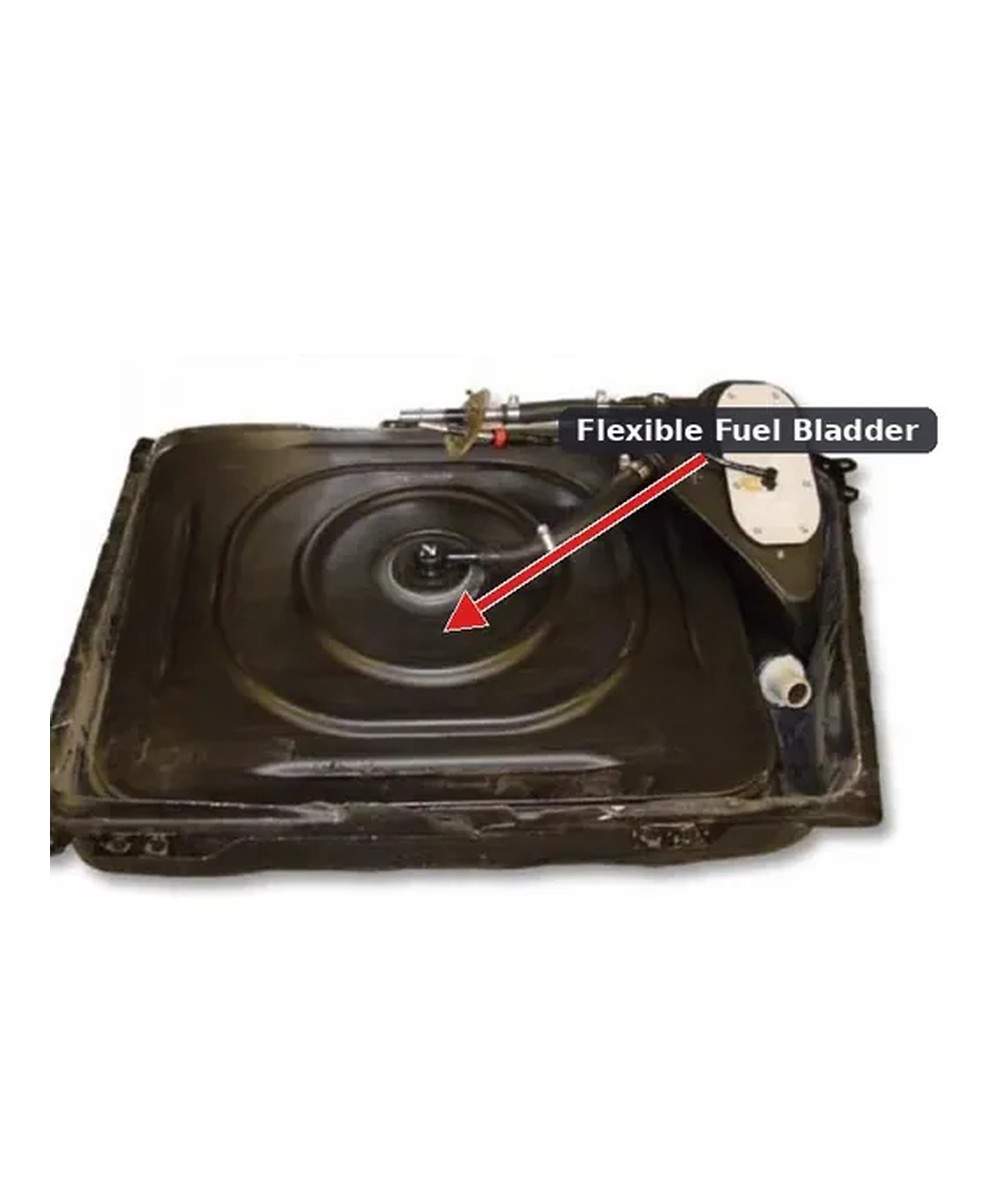
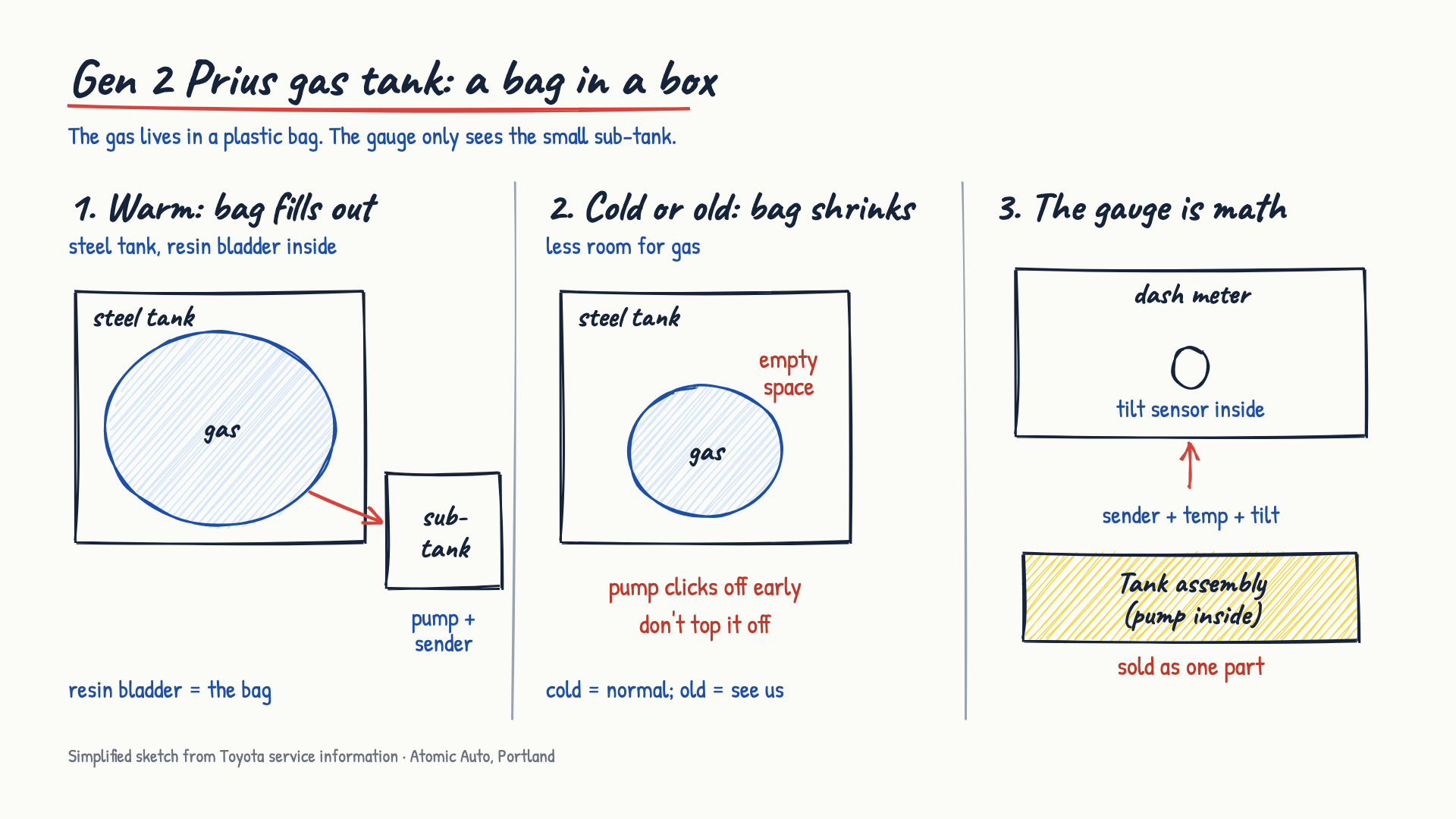
Toyota's answer on the Gen 2 Prius was to shrink that air space. In Toyota's words, the tank "consists of a steel outer structure that contains a semi-flexible rectangular resin bladder." The gas lives inside the bladder. As you burn fuel, the bladder collapses with it, so there's very little air on top of the gas. Toyota's bulletin T-SB-0163-08 explains the goal: "By reducing the air space above the remaining fuel, less vapor will be generated."
Here's how we explain it at the counter. Think of a gallon water jug versus a hydration bladder in a backpack. The jug always has air in it. The bladder squeezes flat as you drink. The Prius tank is a steel box with a hydration bladder inside.
The fuel pump doesn't sit in the bladder itself. Toyota says gas moves from the bladder into a smaller rigid sub-tank, and "the sub-tank contains the fuel pump, fuel filter, and the fuel level sender." That detail matters later, because the fuel gauge only measures that sub-tank, and because the pump is part of the tank assembly.
Why your Prius takes less gas in the winter
The bladder is plastic, and plastic stiffens in the cold. Toyota says it plainly: "When cold, the bladder will contract and become more rigid decreasing its volume." So the same car that took a full fill in August may click off early in January. Toyota calls this "normal for refuel capacity to vary with fuel temperature, fuel pump filling rate, and ambient temperature."
Toyota also admits that the amount you can add after the gauge reads empty "can be less than the specified tank capacity." So if your Prius never takes the full rated amount, that alone doesn't mean anything is broken.
Why the 2010 Prius dropped the bladder
Toyota didn't keep this design. Its 2009 technician magazine announced the change for the next car: "The bladder-type fuel tank has been discontinued on the 2010 Prius and is replaced with a multilayered plastic tank." The same note says the 2010 Prius "uses the Key OFF EVAP System," a different way of catching fuel vapor.
Toyota didn't say why in anything we could find. The car press at the time read it as a fix. Green Car Reports called the new tank a correction to "an irritating problem with its predecessor," meaning the winter shrink. It also reported that "In switching to a standard rigid tank, Toyota added a conventional vapor-recovery system," which let the 2010 keep its California low-emission rating.
For owners, the takeaway is simple. The Gen 3 Prius, starting with the 2010, has a rigid tank with no bag inside. Everything on this page is about the 2004–2009 car.
When the bladder stops coming back
Cold weather is the normal part. The part that brings these cars to us is when the tank stays small. These cars are now 17 to 22 years old. With age, the bladder itself can shrink and stop opening back up all the way. In our shop, we see Gen 2 tanks that take less gas than they used to in every season, and gauges that no longer match what's really in the tank. Toyota's bulletin only talks about the temperature effect, so this part comes from what our technicians see and write down.
On a 2007 Prius, the owner told us the tank was full but the near-empty block was still flashing. Our technician wrote:
Performed the inclination sensor reset and still the fuel gauge reads empty. This generation of Prius contains a bladder inside the fuel tank. This may be the issue.
That car got a used fuel tank assembly, and after that the gauge worked right. On another 2007 that had run out of gas, we added $20 of fuel and our notes say "It only put 2 bars of fuel on the gauge." The technician suspected "the bladder in the tank or the fuel sending unit itself."
Running out of gas on a Prius is not like running out on a regular car. It can light up the dash and set hybrid trouble codes. We've written up a Prius that ran out of gas with three bars on the gauge, and one where an owner replaced thousands of dollars in parts when the car just needed gas. A gauge you can't trust is the real problem. The bladder is how you get there. Every Prius code we've written up is on our Toyota hybrid and EV trouble codes page.
How the Gen 2 fuel gauge actually works
The gauge on a Gen 2 Prius doesn't read the tank directly. The meter works it out. Toyota says the fuel level "is calculated by the combination meter ECU using information from the fuel level sender, fuel temperature sensor, and vehicle inclination sensor (located in the combination meter assembly.)"
The combination meter is the dash display. Inside it is an inclination sensor, a small tilt sensor. It corrects the reading when the car sits nose-up, nose-down, or leaning to one side. Toyota says that information is used "to compensate for the fuel level changes in the sub-tank caused by the vehicle's stance, front to back and side to side."
That design explains two things owners notice:
- Small fill-ups may not register. Toyota recommends adding at least 3 gallons. "If less than 3 gallons is added, the fuel gauge may NOT change after refueling." A $10 splash can leave the gauge exactly where it was.
- The gauge can be one bar off and still be working. After a reset, Toyota says it "may be normal for the fuel gauge display to change approximately one bar higher or lower."
The inclinometer reset: what it does and what it doesn't
You'll find forum posts telling you to do the inclinometer reset, a button sequence on the trip odometer, to fix a Gen 2 gauge. It's a real procedure. Toyota's service manual has it, and we've done it. On a 2009 that came in after a dead 12 volt battery, our technician "Re-calibrated fuel gauge inclinometer" and noted that "It is normal that the fuel gauge will flash at empty when the 12 volt battery dies."
But the reset is not a general fix, and Toyota is clear about when to use it. It "should ONLY be done if the combination meter was removed from the vehicle during service or if it was previously done incorrectly." What it does is teach the meter what level ground looks like. Toyota says it "does NOT cause the fuel gauge to fully recalculate the fuel gauge value."
Level also means very level. Toyota calls for within 0.3 degrees front to back and side to side, done "on an alignment rack if possible," and warns that "a service bay floor should NOT be considered a perfectly level surface unless verified." A driveway is not level. If you do the reset on a slope, you teach the gauge the wrong idea of flat, and Toyota lists a bad reset as one of the reasons to redo it. We don't recommend doing this one at home.
When a shop checks a Gen 2 gauge the way Toyota lays it out, the steps are: measure the fuel sender at the tank and compare it to the bars on the dash. If they match, Toyota says "the system is operating as designed and NO repair should be attempted." If they don't, the first reset is pulling the DOME fuse for 10 seconds, not the inclinometer sequence. Only after that do we look at the sender, the meter, or the tank.
Don't top it off
When a tank clicks off early, the natural move is to keep squeezing the handle or set the pump on its slowest setting. On this car, that can cost you money. Toyota tells technicians: "DO NOT suggest refueling using the lowest setting on the fuel nozzle. This can cause overfilling and possible damage to the EVAP system." Their advice is to let it fill "until the fuel nozzle shuts off by itself. Do NOT 'top off' the fuel tank."
We've seen what happens. On a 2005 with a P1455 code (the code for the vapor-reducing fuel tank system), our technician found the vent hose full of gasoline:
We normally only see this happen if the tank is been filled beyond when the click from the handle happens.
Gas in the vent lines can set evaporative codes and fail an emissions test. Our Prius EVAP codes article covers that side. One more thing to know: a pump that keeps clicking off can also be a vent problem, not a full tank. On a 2008 that wouldn't take gas, our notes read: "a fault in the vent valve or canister can make the pump shut off early even when the tank is not full." That's worth testing before anyone blames the bladder.
What a new tank costs, and your options
There's no bladder sold by itself. Toyota sells the tank as a complete assembly, and the fuel pump comes with it. For a 2007 Prius, one online Toyota parts dealer lists the fuel tank assembly, part 77001-47090, at an MSRP of $2,293.75. That's the part alone. Once the tank is dropped, swapped, and the fuel moved over, a new tank runs multiple thousands of dollars installed. That's a lot of money for a car this age, and it's why we always talk through options first.
Here's how we lay it out:
- Rule out the cheap stuff first. Add at least 3 gallons at a time. Fill until the pump clicks once, then stop. Have a shop check the sender against the gauge and do the fuse reset. Test the EVAP vent if the pump clicks off early.
- Replace the tank if the gauge is the problem and you need it fixed. We've installed used tank assemblies on Gen 2 cars and had good results, and they cost less than new. But a used tank has a bladder about as old as yours, and it can have the same problem, now or later. It's a gamble that sometimes pays off.
- Replace it new if you're keeping the car a long time, or if the fuel pump has also failed. Because the pump is inside the assembly, a dead pump on a Gen 2 means a tank either way.
- Or live with it. If the tank holds gas, doesn't leak, and doesn't set codes, a short tank and a bad gauge are a nuisance you can manage. The one rule is that you stop trusting the gauge.
A tank with a P1455 code is a different story. On a 2006 we checked before purchase, our technician explained the code: "This fault is stored when the ECM detects fuel leaks from inside a bladder tank to the fuel tank." That's a check engine light, and in Oregon a check engine light means the car won't pass DEQ. If you're shopping for a Gen 2, a pre-purchase inspection will catch it. Our used Prius buying guide covers the rest.
The old-school way: live with it using the trip odometer
This is how a lot of people tracked gas before cars told them anything. On a Gen 2 Prius with a tired bladder, it's more reliable than the gauge. Here's the routine we suggest:
- 1. Fill up the same way every time. Let the pump click off once. Don't top off.
- 2. Write down the gallons from the pump and reset a trip odometer right there at the station.
- 3. At the next fill-up, divide. Miles on the trip meter divided by gallons you just added is your real fuel economy.
- 4. After a few fills, you'll know your tank. You'll see roughly how many gallons it takes in summer and in winter, and how far you went on each.
- 5. Set a refuel mileage with a cushion. Take the smallest fill you've seen, multiply it by your fuel economy, and plan to fill up well before that number. From then on, the trip meter tells you when to buy gas.
A small notebook in the glovebox or a note on your phone is all it takes. It also tells you when something changes. If your fuel economy drops or your fills get smaller fast, that's worth a visit. We've written about what changes Prius fuel economy too.
One warning: if a shop does the inclinometer reset on your car, Toyota's procedure sets Trip A back to zero. Use Trip B for your fuel tracking, or write the number down before you drop the car off.
Frequently asked questions
Why won't my Prius take a full tank of gas?
On a 2004–2009 Prius, the gas is stored in a plastic bladder inside the tank. It shrinks when it's cold, so it holds less in winter, and Toyota calls that normal. If it takes much less than it used to all year round, have the gauge, the EVAP vent, and the tank checked.
Will the inclinometer reset fix my Prius fuel gauge?
Usually not. Toyota says to do it only if the combination meter was removed or the reset was done wrong before. It has to be done on very level ground, and it doesn't recalculate the fuel level. A shop should test the fuel sender first.
Is it safe to drive a Prius with a bad fuel gauge?
Yes, if you track fuel by miles instead of the gauge and fill up early. The risk is running out of gas, which on a Prius can set hybrid warning lights and leave you stranded.
Can you replace just the bladder in a Prius gas tank?
Toyota doesn't sell the bladder separately. It comes as part of the fuel tank assembly, along with the fuel pump. A new assembly runs multiple thousands of dollars installed. A used one costs less but can have the same shrunken bladder.
Questions about your car? Text us at 503-969-3134 — it's the fastest way to reach us.
About the author: Travis Decker is the owner of Atomic Auto in Portland, Oregon, and an ASE Master Technician (L1, L3). Atomic Auto specializes in Toyota, hybrid, and EV service.
General information from the cars that come through our bays. Yours is its own case, and we would rather test it than guess.
Text us, or book a slot.
A text with a photo of the dash gets you an answer fastest. Booking online holds a day and a time.