
Toyota Prime Heat Pump Systems: The Complexity Behind an A/C Repair
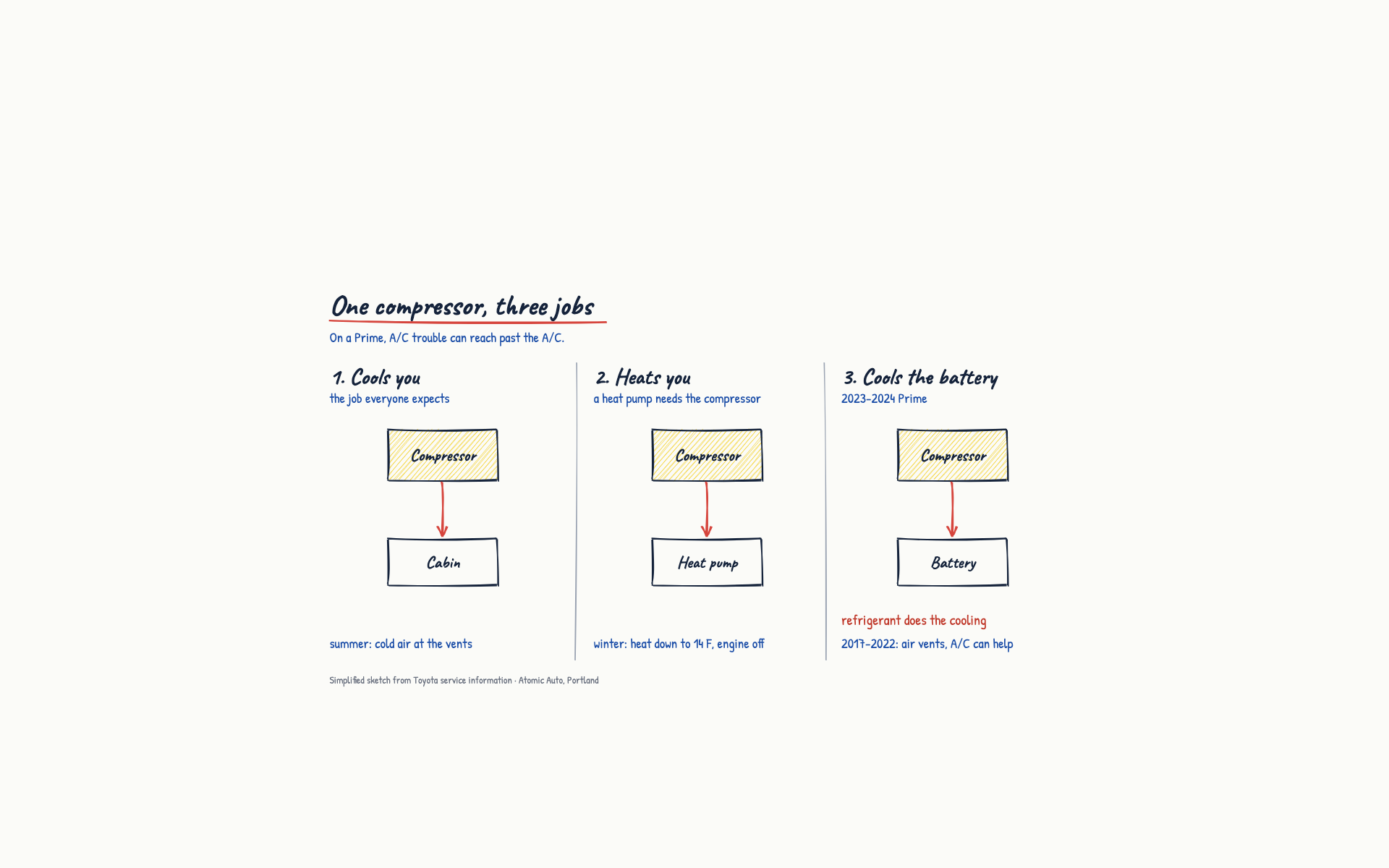
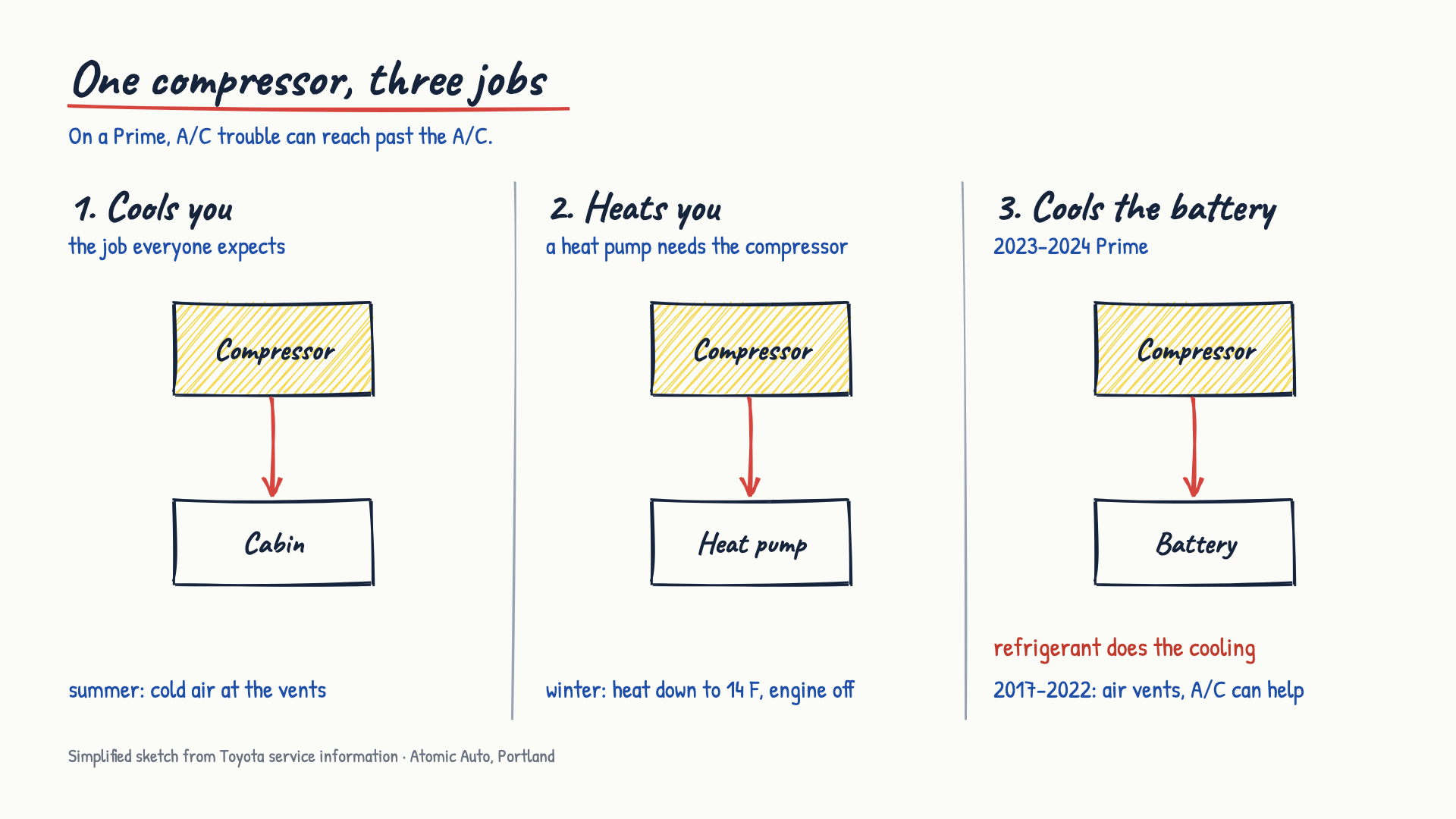
Short version: The heat pump system on a Toyota Prime is far more complicated than ordinary car A/C. It cools the cabin, heats the cabin, and on the RAV4 Prime and the 2023-2024 Prius Prime, the refrigerant also cools the hybrid battery. That complexity is why we recommend avoiding plug-in hybrids: there's more to fail, and the repairs get bigger when it does. Stick with a regular hybrid, or get an EV. Owner reports of A/C compressor failures show what that can look like, with repair figures from $6,250 to $11,572. We have never seen that failure in our shop, and nobody has shown how often it happens, so we won't call it a known problem. If you're set on a Prime anyway, test the A/C and the heat yourself, find out who pays before you need to know, and don't buy a car with dead A/C unless the price covers the worst case.
The compressor is one example. The bigger point is how much depends on this one system, and how little anyone outside Toyota knows yet about how it holds up.
Why a Prime's heat pump system is so complicated
An electric compressor isn't what sets a Prime apart. Regular Priuses have those too. The difference is everything else the refrigerant system does. The Car Care Nut calls the RAV4 Prime's setup "the most complicated HVAC system ever put in a car," and the video below is the best walk-through we know of. Watch it if you're thinking about buying a Prime.
It makes heat. Toyota says the Prime's heat pump "can function without the engine running in weather down to 14 degrees F" (Toyota's 2022 Prius Prime overview). A heat pump needs its compressor, so a Prime's compressor can be working in January as well as July. Whether that extra work shortens its life, nobody has shown.
On 2017-2022 Prius Primes, it helps cool the battery. This battery is mainly cooled by air. Toyota's owner's manual for this generation says "There are air intake vents on both sides of the rear seatback for the purpose of cooling the hybrid battery (traction battery)." It also describes a Traction Battery Cooler function that protects a hot battery "by using the vehicle air conditioning to cool it before charging is carried out." Toyota doesn't say how the cold air gets there, and the function can be switched off.
On 2023-2024 Prius Primes, refrigerant cools the battery. Toyota's New Car Features document (a copy posted on PriusChat) says "A battery cooling system is used to perform cooling of the HV battery which uses refrigerant." The same document lists a heat pump ECU, solenoid valves, and electric expansion valves. The regular non-plug Prius of this generation still has "an air intake vent under the left side of the rear seat" (owner's manual), so this is a Prime story. The RAV4 Prime documents also describe a "refrigerant cooling system" for the HV battery. We haven't reviewed 2025 and newer Prius Primes.
We couldn't find a Toyota document that says what a 2023-2024 Prime does when that battery cooling stops working. The owner's manual does say charging can stop "to protect the hybrid battery (traction battery) as it continued to remain hot for a certain period of time." On the RAV4 Prime, The Car Care Nut puts it plainly: when the A/C goes out, "you must fix it." We wouldn't treat dead A/C on a refrigerant-cooled Prime as a comfort problem you can put off either.
One example: what owners report about compressors
These come from one thread and another on the Prius Prime subreddit:
- A 2018 Prime, bought with A/C known not to work. The owner says they were told the compressor had "disintegrated", spreading metal fragments through the system. They report a $6,250 dealer quote and "at least 10K" from their regular shop, and later "over $9K" once an accumulator assembly was added.
- A 2024 Prime. A commenter says the compressor went bad and "the warranty cost was $11572."
- A used 2024 Prime. A commenter says the compressor was "quite loud," then faults showed up and the A/C quit 1,500 miles later. The seller's warranty covered it. They put the bill at $8000-9000.
- Another 2024 Prime with weak A/C. The owner says Toyota "did find like, metal shavings inside" and did a major repair under warranty.
Those are forum posts. We haven't seen the invoices, we don't know what was replaced, and we can't tell a real bill from an estimate or from what a warranty claim paid. People with a bad experience post. People whose A/C works don't.
What we've seen in our shop
We went through our records: 57 Prius Primes and 146 closed repair orders. We have never seen a Prime compressor come apart and send metal through the system.
Only one of those repair orders involved a compressor, and it's a different story. A 2020 Prime came to us after a collision. Another shop had already replaced the compressor, and it still wasn't cooling. We found no relevant climate codes, and our technician noted: "The heat pump assembly is in the right front corner. This is also the corner that was repaired." So on that car, a new compressor didn't fix the A/C, and the crash damage was the first suspect. Ask about front-end collision repairs.
The Car Care Nut said something similar about the earlier Prius Prime, which he says "really didn't have issues unless the car was in an accident" or was worked on by someone who didn't know the system.
That doesn't prove the failure isn't happening. Nearly all the Primes we've seen are 2017-2022 cars, most of the posts above are 2024s, and a car still under warranty is likely to go to a dealer instead of to us.
Compressor failure and contamination are two different jobs
A compressor can stop working without shedding anything. That's a compressor job. One that fails internally is a bigger worry. As our technician wrote on an older Prius: "If the compressor has failed internally, then it is possible that debris has entered the system and could cause premature failure of the system moving forward." On a Prime, that system has more parts in it.
We've never done this job on a Prime, so this next part is our opinion. We think shops are likely over-quoting it. If the whole system truly had to be replaced on an older Prime, that would likely total the car. Before anyone reaches that conclusion, ask:
- Did someone actually see debris, or are they assuming it? Ask for photos.
- Which parts are on the list, and why each one?
- Which Toyota repair procedure calls for that scope?
Who pays: what Toyota's warranty guides say
We read Toyota's Prius Prime warranty guides for 2017 through 2024. We did not review RAV4 Prime guides. Check the guide for your exact model and year.
- Basic warranty. "Coverage is for 36 months or 36,000 miles," per Toyota's guide.
- Hybrid warranty. You'll see owners say the compressor is covered as a hybrid part. The 2023 guide's 8-year or 100,000-mile list names the hybrid battery control module, the hybrid control module, and the inverter with converter. The compressor isn't on it.
- Emissions warranty, 2023 and 2024. These guides do list the compressor, under "PARTS LIST: LONG-TERM EMISSION DEFECT WARRANTY," along with the air conditioner amplifier, pressure sensor, expansion valve, and magnetic valve. That list says "The parts listed here are covered for seven years or 70,000 miles from the vehicle’s in-service date, whichever occurs first."
- Emissions warranty, 2017-2022. The guides we read for these years don't list the compressor.
Oregon has a wrinkle. The 2023 guide also has a clause, "For 15 years or 150,000 miles," for when "any emissions-related part is defective." A footnote applies it to Oregon vehicles, among other states, "equipped with a California Certified Emission Control System." Some owners argue that makes the compressor a 15-year part here. The guide doesn't say that. It prints the compressor only on the seven-year list, so we don't know how Toyota applies it. Get an answer in writing, and don't buy a car counting on it. Washington is grouped differently, and one Washington owner reports being told this coverage wasn't in effect there, so ask before you buy across the river.
Even a covered compressor may not mean a covered system. The guide says "Toyota shall not be liable for incidental or consequential damages." We don't know how that plays out when debris has damaged other parts.
As of November 2026, we found no A/C recall in NHTSA's results for the Prius Prime, no compressor-specific bulletin or support program in the listings we checked, and no NHTSA complaint under Prius Prime that uses the word "compressor." We can't see everything Toyota has, so have a Toyota dealer run the VIN. So today this is owner reports, with no published failure rate.
What we'd check before buying a Prime
- Run the A/C and the heat. Both. Feel the vents and listen. A loud compressor alone doesn't condemn a car, but new or worsening noise should be diagnosed before you hand over money.
- Get it inspected. Have a shop scan every system, not only the engine. Here's what we look at on a used hybrid inspection.
- Ask for the history. Look for A/C work and front-end collision repairs.
- Ask if anyone used a recharge can. On an older Prius we noted: "Since the system was recharged with a DIY can, there is a possibility that there may have been some damage done." Toyota's 2023-2024 document says "Always use ND-OIL 11 as the compressor oil."
- Price dead A/C at the worst case. The 2018 owner above negotiated a couple of thousand off to cover it. That may not be enough. If the seller says it "just needs a recharge," the seller can recharge it first.
Where this leaves us on plug-ins
We haven't seen a compressor pattern here, and we're not saying every Prime will have this problem. The compressor is just one specific example of the complexity. Our advice on plug-ins is the same as in our used hybrid and EV guide: we recommend avoiding them. A plug-in hybrid has more systems to maintain, and that complexity can show up on the repair bill later. If you want a hybrid, get a regular hybrid. If you want an EV, get an EV. If a regular Prius is on your list, our used Prius guide is a good next read.
Questions about your car? Text us at 503-969-3134 — it's the fastest way to reach us.
About the author: Travis Decker is the owner of Atomic Auto in Portland, Oregon, and an ASE Master Technician (L1, L3). Atomic Auto specializes in Toyota, hybrid, and EV service.
General information from the cars that come through our bays. Yours is its own case, and we would rather test it than guess.
Text us, or book a slot.
A text with a photo of the dash gets you an answer fastest. Booking online holds a day and a time.