
What Is an EVSE? Why the Real Charger in Your EV Is Inside the Car
Short version: On most EVs, the real charger is inside the car. The cord in your trunk and the box on your garage wall are EVSE, which stands for electric vehicle supply equipment. Your EVSE passes power to the car and talks to it, and the car does the charging. When charging stops at random, stop using anything that looks damaged or hot, check the car's charge timer, then try a different EVSE. That one swap tells you more than anything else you can do at home.
We hear this question a lot: sometimes the car charges fully, sometimes the charge gets interrupted, and the owner can't tell whether the problem is the charger or the car.
That's the right question. To answer it, you need to know what each part does, because the thing most people call a charger isn't doing the charging.
What is an EVSE?
The U.S. Department of Energy puts it plainly: "EVSE is the equipment used to deliver electrical energy from an electricity source (such as the electricity running to your home’s outlets) to a PEV." A PEV is a plug-in electric vehicle. The same handbook adds: "EVSE communicates with the PEV to ensure that it supplies an appropriate and safe flow of electricity." (DOE Plug-In Electric Vehicle Handbook for Consumers)
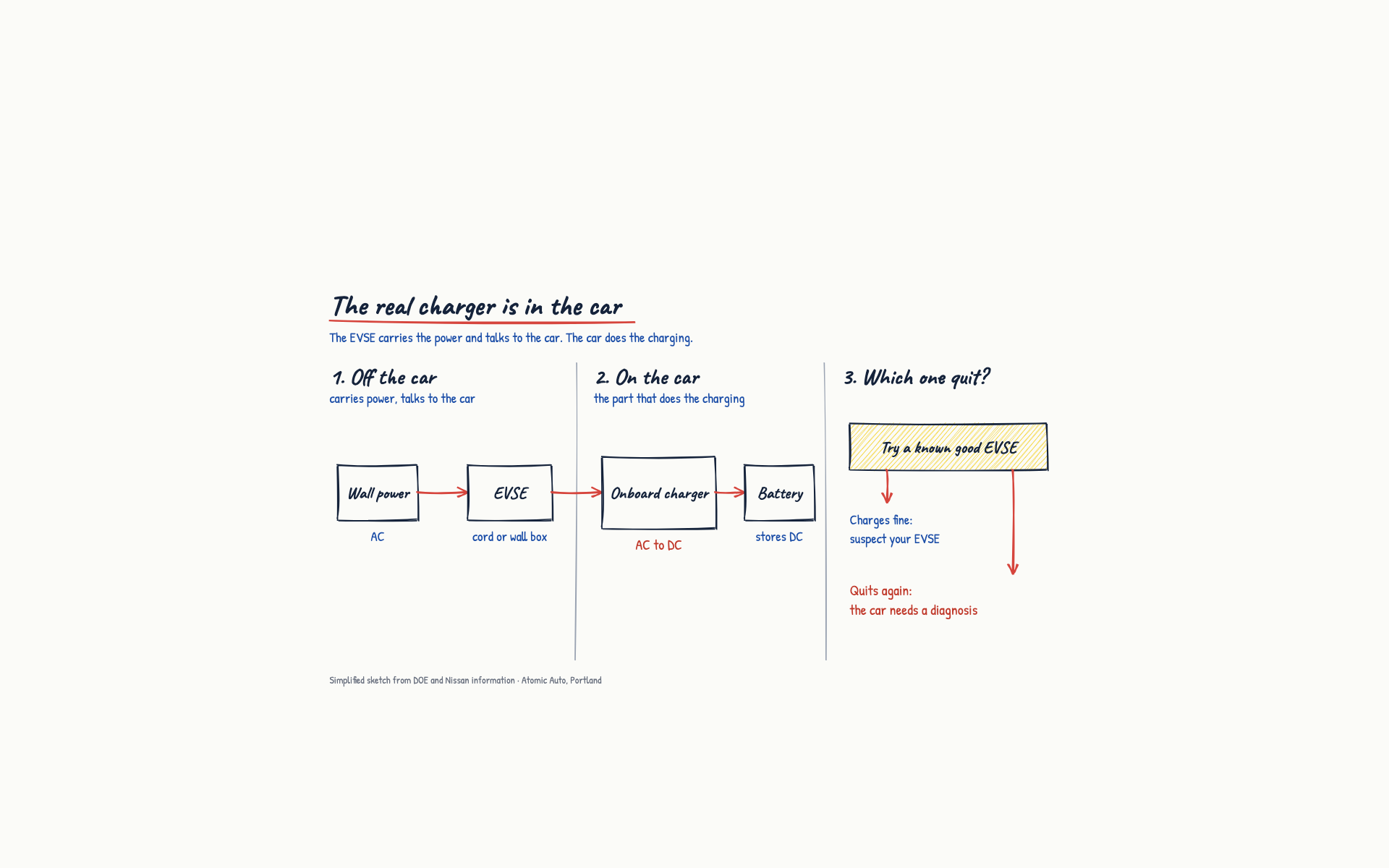
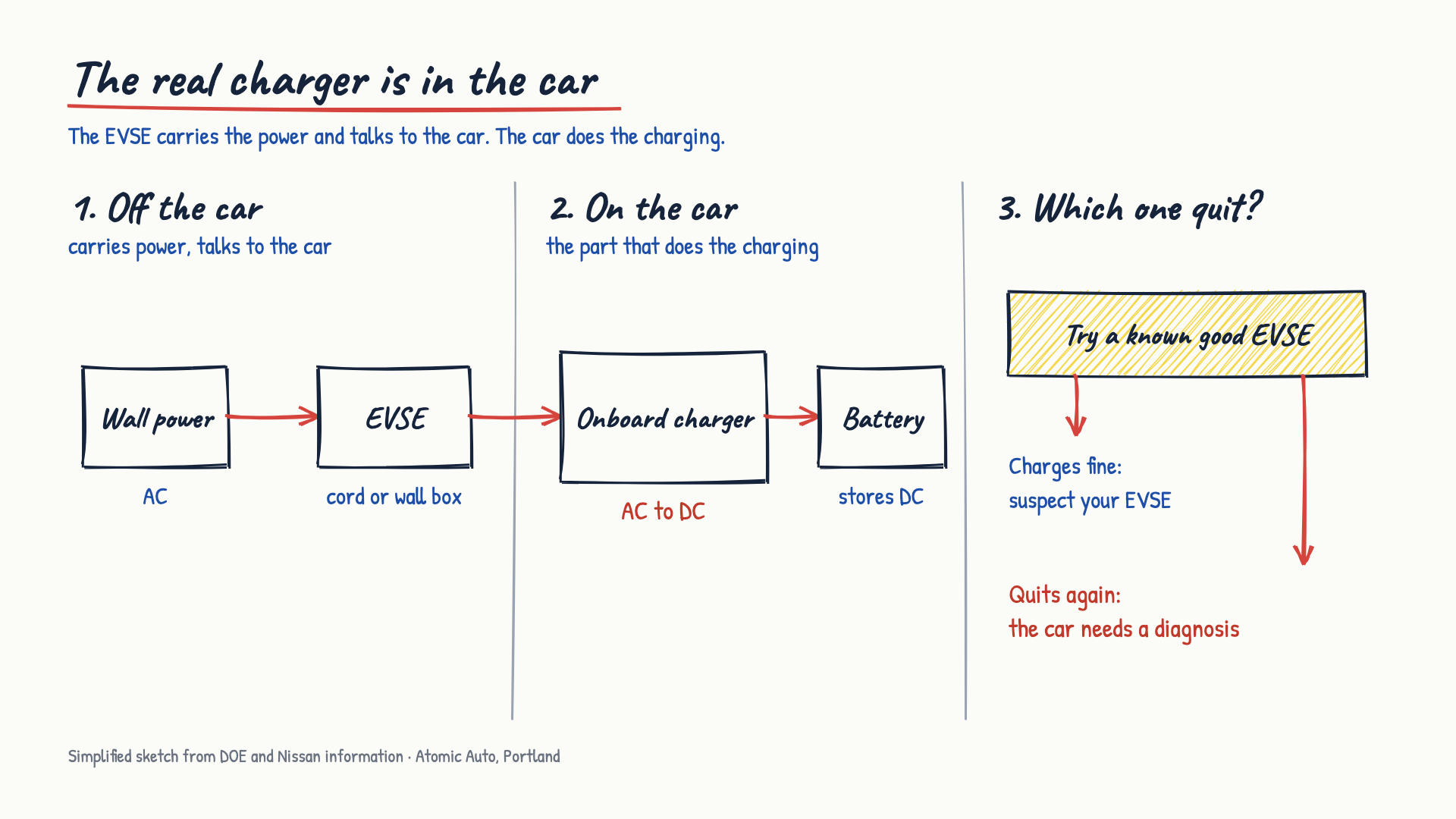
So an EVSE has two jobs: it carries power, and it talks to the car about that power. The portable cord and the wall unit both do this. The wall unit is usually the bigger version, on a 240-volt circuit.
The conversion happens somewhere else. The DOE handbook says Level 1 and Level 2 equipment "provide alternating current (AC) electricity to the vehicle, with the vehicle’s onboard equipment converting AC to the direct current (DC) needed to charge the batteries." A battery stores DC, your house supplies AC, and the part that turns one into the other rides around in the car. That is the charger.
The sketch below shows the whole path, plus the test we'll get to in a minute.
The exception is the fast charger at a public station. The same handbook says DC fast charging "provides DC electricity directly to the vehicle." With that equipment, the big cabinet is doing the conversion that your car does at home.
Everybody calls the cord a charger anyway, Nissan included. The warnings in its LEAF owner's manual say "Discontinue charger use immediately if plug or outlet becomes hot to the touch or if you notice any unusual odors," and they are talking about the cord. We won't fight anyone over the word. What matters is that there are two systems, one on the car and one off it, and either can stop a charge.
Try a different EVSE first
If nothing looks damaged or hot, this is what we recommend before anything else. Plug the car into different equipment and see what it does. A public Level 2 station works, and so does a friend's charger or your other cord.
It's the same test Nissan gives technicians in a service bulletin on a charge cable that won't charge, which says to "plug a known good EVSE charge cable into the vehicle" and see whether it charges. You don't need any tools for it, and it splits the problem in half.
- It charges fine: If the car charges fine on the other equipment over several sessions, your first EVSE moves to the top of the list.
- It quits again: If it quits on known good equipment too, the car needs a diagnosis.
One good charge doesn't prove much when the problem comes and goes, so give it a few sessions. And if a charge quits when someone steps on the cord or bumps it, we'd look at the cord or the connection before we'd look at the car. That's our opinion, not a verdict, but it fits Nissan's own list of what can stop a charge partway through.
Why a charge stops partway
The troubleshooting table in the Nissan LEAF owner's manual lists several causes for "Normal charge stops in the middle of charging." None of these four means the car is broken:
- Power went away. "There may have been a electrical power failure, or the breaker may have failed."
- The cable came loose. "Check that the charge cable has not been disconnected."
- The connector button got held down. "If the charge connector button is pressed for a long period of time, charging will be stopped."
- The timer ran out. "When charging timer is set and the charge end time is reached, charging will be stopped, even if the Li-ion battery is not fully charged."
One more detail makes this feel random. If power to the EVSE drops and comes back, the manual says "Charging will restart automatically when the electrical power to the EVSE is restored if the charging connector is connected." It also says "The charge start beep will not sound when charging restarts." So a charge can stop and start again overnight, and you'd never hear it.
If you drive something other than a LEAF, your manual will read differently. The habit carries over: check the simple causes before you assume the expensive one.
What to do when your EV stops charging
- Stop if anything looks wrong. If the plug or outlet is hot, smells odd, or looks burnt, unplug and leave it unplugged. We wrote up what happens next in why EV charging outlets melt. Nissan also says "Do not operate with a damaged cord."
- Check the timer and the breaker. Look at any charge timer in the car, and make sure the breaker is on.
- Read the lights on the cord. The LEAF's EVSE has a control box whose indicator light shows charging status and "also indicates if there is a EVSE (Electric Vehicle Supply Equipment) malfunction." Yours may have something similar. Write down what it shows, or take a photo. Some of those lights mean stop. For an electric leakage or an EVSE malfunction, Nissan's instruction is "Stop use immediately and contact a NISSAN certified LEAF dealer."
- Write down the pattern. Note which cord, which outlet, and what was going on when it quit. Small details like that help, because an intermittent problem may never show up in the shop.
- Try a different EVSE. Use the test above, and give it several sessions.
- Do not open it or tape it up. Nissan's manual says "The charger contains no user serviceable parts." It also warns "Do not disassemble or modify the charge port or the EVSE (Electric Vehicle Supply Equipment). This may cause a fire."
- Bring the cord with the car. If you come to us, bring every cord you use, so we can test the car and your equipment on the same visit.
How to treat your cord
A charge cord has a rough life on a garage floor. Nissan's cautions for protecting the equipment include "Do not subject the charging equipment to impact." and "Do not pull or twist the charge cable." and "Do not drag the charge cable." We'd add one of our own: keep the cord where feet and tires won't find it, and hang it up when you're done.
Nissan is also firm about the wall side: "Never use extension cords or plug adapters with charger."
When it really is the car
Sometimes the swap test points back at the car, and that repair can be costly. We wrote up one of those in Nissan LEAF won't charge: it might be the PDM. That's why the cheap test comes first. Nobody wants to buy a new wall unit and find out the car was the problem.
Shopping for a used EV? Ask for the cord too, and look it over. Our used Nissan LEAF guide and our used hybrid and EV guide cover the bigger questions.
Frequently asked questions
Is an EVSE the same thing as a charger?
Most people use the words the same way, and that's fine in conversation. Technically, an EVSE delivers power to the car and talks to it. For Level 1 and Level 2 charging, the car's onboard equipment converts that power for the battery.
If my car has a charger inside, why do I need a wall unit?
The car still needs something between it and the power source that talks to it and supplies a safe flow of electricity. That's the EVSE. A wall unit is one kind. The cord that came with the car is another.
Can I keep using a cord that cuts out sometimes?
We wouldn't. If it's damaged, Nissan says not to operate it. If it looks fine but acts up, use other equipment until you know what you're dealing with.
My charge stopped overnight, but the car is fine now. Should I worry?
One stop with a clear reason, such as a power blip or a timer, is usually not a worry. A pattern is worth chasing, so write down what happened each time and text us.
Questions about your car? Text us at 503-969-3134 — it's the fastest way to reach us.
About the author: Travis Decker is the owner of Atomic Auto in Portland, Oregon, and an ASE Master Technician (L1, L3). Atomic Auto specializes in Toyota, hybrid, and EV service.
General information from the cars that come through our bays. Yours is its own case, and we would rather test it than guess.
Text us, or book a slot.
A text with a photo of the dash gets you an answer fastest. Booking online holds a day and a time.