
Short version: An EV charger pulls a lot of current for hours at a time. A regular household outlet was never designed for that. If you can, have your charger hardwired. If you have to plug in, use an EV-rated or industrial-grade outlet, and turn the charge current down in the car or the app unless you really need the full rate. The photo below is what happens when none of that is done.
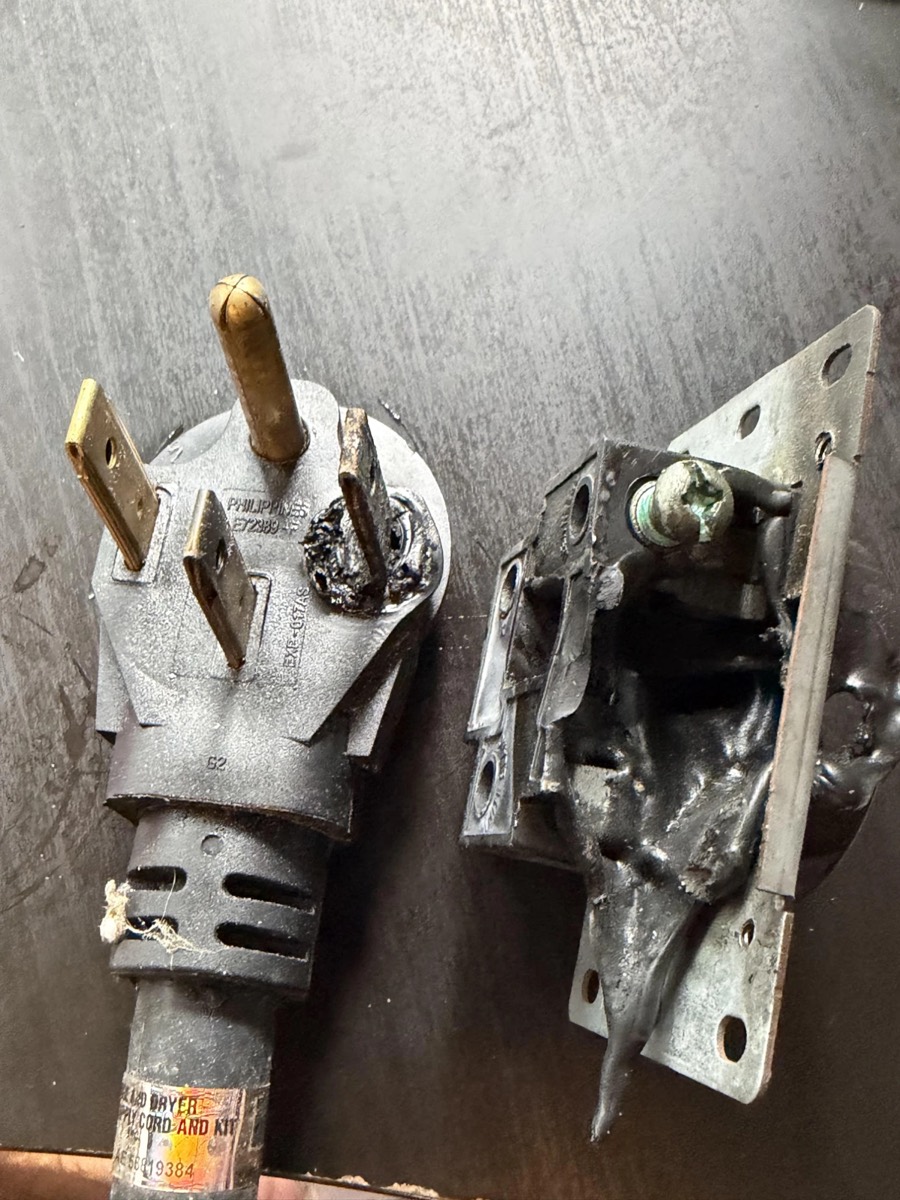
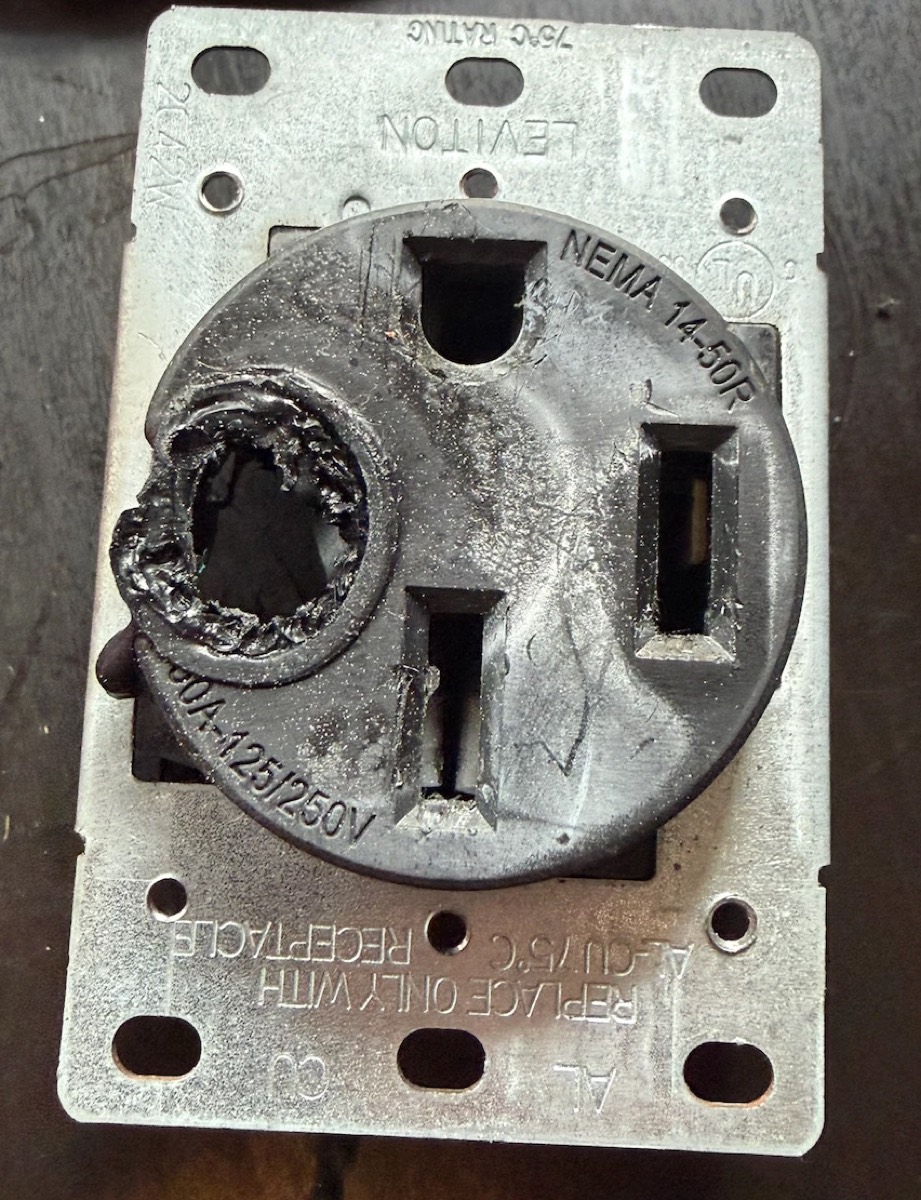
This one is mine. I charged my 2022 Tesla Model Y at home on a standard residential Leviton 14-50 range outlet, the kind in every hardware store, with the charger set to 40 amps. The plug was no better: a cheap dryer cord I had used to make up the charger’s lead. It ran that way for about four years before I noticed the plug and the outlet had burned. Nothing tripped, nothing faulted, and the car kept charging. I only caught it by looking. If it can happen in the garage of a shop that works on EVs every day, it can happen in yours.
Three things went wrong at once. The outlet was a range outlet, the plug was a dryer cord, and neither was built for a continuous 40-amp load. And 40 amps is not really “turned down” on a 50-amp circuit. It is the maximum the code allows, all night, every night.
Why an EV charger is different from a dryer or a range
A dryer runs for 45 minutes and cycles its heating element on and off. A range heats up, then the thermostat backs it down. An EV charger draws its full current, flat out, for six or eight hours, night after night.
The electrical code treats it that way. NEC Article 625, which covers EV charging, says: “Electric vehicle charging loads shall be considered to be continuous loads for the purposes of this article” (NEC 625.42). A continuous load can only use 80% of the circuit. On a 50-amp circuit that is 40 amps. On a 30-amp dryer circuit that is 24 amps (the 125% rule, explained).
Every metal-to-metal connection in that path has a little resistance: the terminal screws, the contacts inside the outlet, the blades of the plug. Current flowing through resistance makes heat, and the heat goes up with the square of the current. A slightly loose screw or a worn contact that would never matter on a dryer becomes a small heater inside the wall when it runs at 32 or 40 amps all night. The plastic softens, the contact gets looser, resistance goes up, and it gets hotter. That is the loop that produced the photo above.
The three kinds of 14-50 outlet
Most plug-in Level 2 chargers use a NEMA 14-50 plug, the same four-prong outlet as an electric range or an RV pedestal. There are three grades of that outlet, and from the front they look almost the same.
Residential range outlet, about $10 to $25. This is the Leviton 279 or Eaton 1258 you find in the big-box electrical aisle. It is built for a range that cycles. Leviton’s own product page for its EV outlet now says of the standard 279: “Not Recommended for Electric Vehicle Charging (See Leviton EV Outlets)” (Leviton 1450W page). Tom Moloughney at State of Charge has documented burned 14-50 outlets of this type more than once, and in one Hillsboro rescue the fix was to hardwire the charger.
Industrial or commercial grade, about $50 to $70. The Hubbell HBL9450A and Bryant 9450FR. Hubbell’s spec sheet lists “Contacts—Brass” and “Box Terminals—Copper,” a heavy steel mounting strap, and a 75°C continuous rating (Hubbell HBL9450A spec sheet). These were the go-to for EV charging before anyone sold an “EV” outlet, and they still work well.
EV-rated, about $50 to $75. The Leviton 1450R (indoor) and 1450W (weather-resistant). Leviton says these are “Designed specifically for plug-in EV charging applications” and “Designed to sustain the necessary extended charge time and high frequency of insertions EV chargers require.” The specific changes are “heavy-gauge, high-performance copper contacts” and pressure-wire terminals that “require 75 in lbs., substantially higher than traditional power outlets” (Leviton 1450R/1450W product bulletin). It only accepts #4, #6, or #8 copper wire, no aluminum.
The price difference between the cheap one and the right one is about $50. The photo above cost a lot more than that.
What we actually recommend
Hardwire the charger if you can
Most of the time, this is the right answer. A hardwired charger has no plug, no outlet, and two fewer connections to loosen or corrode. It also removes the code concern about pulling a plug under load. NFPA’s own record for the 2025 code warns that a 14-50 “require[s] that the receptacle be de-energized prior to inserting/removing the mating plug to avoid destructive arcing that could lead to degraded thermal performance and a potential fire hazard” (NFPA 2025 NEC public input record). Have an electrician run a dedicated circuit and wire the unit straight in.
If you must plug in, buy the right outlet and the right plug
Leviton 1450R, Hubbell HBL9450A, or Bryant 9450FR on the wall. Have the electrician torque the terminals to spec and use copper wire. Then look at the other half: the plug on your charger. In my case both halves were the cheap kind, a residential range outlet and a dryer-cord plug. Use the plug the charger came with, or a heavy-duty 14-50 plug from the same makers, and never a dryer cord. And do not put an EV charger on a 30-amp dryer outlet at all. That circuit limits you to 24 amps continuous and the outlet was built for a load that cycles.
Turn the current down
This is the part almost nobody does, and it is the easiest.
- Tesla: The Mobile Connector’s 14-50 adapter runs at 32 amps by default, and Tesla’s own manual tells you how and why to reduce it: “If needed, touch – or + to change the current (for example, you may want to reduce the current if you are concerned about overloading a domestic wiring circuit shared by other equipment).” The car remembers the setting per location: “When you change the current, Model Y remembers the location. If you charge at the same location, you do not need to change it again” (Tesla Model Y owner’s manual, Charging Instructions). Set it on the charging screen in the car or in the Tesla app. We tell Tesla owners to drop it to 24 amps at home and leave it there. I was at 40 on the outlet in the photo. Do not do what I did.
- Hyundai and Kia: In the car: EV Settings, Charging Current, then AC Charger, and choose Maximum, Reduced, or Minimum (Kia owner’s manual).
- Nissan Leaf: The manual has an “Amperage Limit” setting: “Select desired amperage (8, 12, 16, 24 or Max)” (2026 Nissan Leaf owner’s manual).
- Rivian: Under Energy, pick the amps value. One catch from the manual: “When the vehicle completes its charge session, the amperage setting resets to the maximum value if you haven’t set a charge schedule or you’re away from home” (Rivian R1T owner’s guide). Set a home charge schedule so it sticks.
- Ford and GM: The Ford Mobile Power Cord is fixed at 30 amps on 240 volts and the GM dual-level cord at 32 amps, with no amp selector on 240 volts (Ford Mobile Power Cord spec, 2023 Bolt owner’s manual). If you own one of these and want a lower rate on a plug-in outlet, the honest answer is a hardwired charger with an adjustable current setting.
Most people do not need the full rate. A car that sits in the garage from 7 PM to 7 AM gains well over 100 miles at 24 amps. Turn it up to maximum only on the night you actually need it, then turn it back down.
Warning signs to act on now
- The plug or outlet is warm to the touch after an hour of charging. Warm is a problem; hot is an emergency.
- A brown or black mark on the outlet face, or a smell like hot plastic. NFPA lists “discolored or warm wall outlets” and a “burning or rubbery smell” as reasons to call an electrician (NFPA home electrical safety).
- The charger faults or the car reports reduced current. Tesla’s Mobile Connector manual lists the exact fault: “Charging current is reduced due to high temperature detected in the input plug” (Tesla Gen 2 Mobile Connector manual). That is the charger protecting you from an outlet that is already failing.
- The plug feels loose in the outlet. Worn contacts mean high resistance, and high resistance means heat.
If you see any of these, stop charging on that outlet and have an electrician look at it. Do not “just keep an eye on it.”
Frequently asked questions
Is it safe to charge my EV on a dryer outlet?
We do not recommend it. A 30-amp dryer circuit limits you to 24 amps continuous and the outlet was built for a load that cycles on and off. If the dryer circuit is the only 240-volt circuit you have, the safer path is to have an electrician add a dedicated circuit for the car.
Do I need an electrician, or can I swap the outlet myself?
Have an electrician do it. The EV-rated outlets need the terminals torqued to a specific value (75 inch-pounds on the Leviton 1450R), copper wire of the right gauge, and a circuit sized for a continuous load. Most of the melted outlets we hear about trace back to a connection that was a little loose, or a plug that was never meant for the job.
Will turning the current down hurt the car or the battery?
No. Lower AC charge current is easier on everything in the chain, and the car’s battery management does not care how slowly the charge comes in. It just takes longer.
Which is better, the Leviton EV outlet or the Hubbell industrial one?
Either is a big step up from the $10 range outlet. Both use heavy copper or brass contacts and a steel strap. The Leviton is marketed for EVs and the Hubbell has been the electrician’s choice for years. We would not argue with an electrician who prefers one over the other. We would argue with a $10 outlet.
Questions about your car? Text us at 503-969-3134 — it’s the fastest way to reach us.
About the author: Travis Decker is the owner of Atomic Auto in Portland, Oregon, and an ASE Master Technician (L1, L3). Atomic Auto specializes in Toyota, hybrid, and EV service.