
Short version: Counterfeit Toyota and Denso parts have gotten good enough to fool experienced buyers, and they show up in places people trust — third-party listings on Amazon and eBay, and even some parts-store shelves. The fastest tells are on the packaging: the hologram, the faint 5% screen, matching batch codes, and a QR code that actually scans to the maker’s site. And if the price is 50 to 70 percent below the dealer’s, it is almost certainly fake.
A fake handbag costs you money. A fake auto part can cost you your engine, your car, or worse. Counterfeit Toyota and Denso parts have gotten good enough that they fool experienced buyers, and they are showing up in places people trust — third-party listings on Amazon and eBay, and even some parts-store shelves. In the shop we have pulled failed “OEM” parts out of cars that turned out to be counterfeits the owner bought online in good faith. This guide walks through exactly what we look for so you do not get burned.
Before we get into it, watch this teardown from Toyota master tech The Car Care Nut. It shows a real counterfeit part next to the genuine article, and it is the clearest 15 minutes you can spend on this subject:
The counterfeits got good — and that is the problem
Ten years ago a fake part was easy to spot: wrong color box, blurry logo, obviously cheap casting. Not anymore. Today’s counterfeiters clone barcodes, copy holograms, and replicate packaging closely enough to slip into legitimate supply chains. The most common way they reach you is a marketplace listing — a part that looks like genuine Toyota or Denso, sold and shipped by a third party you have never heard of, at a price that looks like a great deal.
This is not a fringe issue. Denso takes it seriously enough to sue: the company won a lawsuit in Russia against sellers pushing counterfeit Denso-branded injectors, forcing them to stop and pay damages, and Denso has issued repeated warnings to distributors about fake spark plugs, wiper blades, and compressors. Globally, counterfeit auto parts are a multibillion-dollar business. The reason your favorite brands get faked is simple — they are the ones people actually want.
The difference between a fake designer bag and a fake water pump is what happens when it fails. A counterfeit part does not just wear out early. It can cause catastrophic engine failure, an under-hood fire, or a sudden loss of power at highway speed. This is a safety issue, not just a value one.
The parts most likely to be faked
Counterfeiters go after high-volume, high-margin parts — the ones every shop and owner buys. These are the ones we watch most closely.
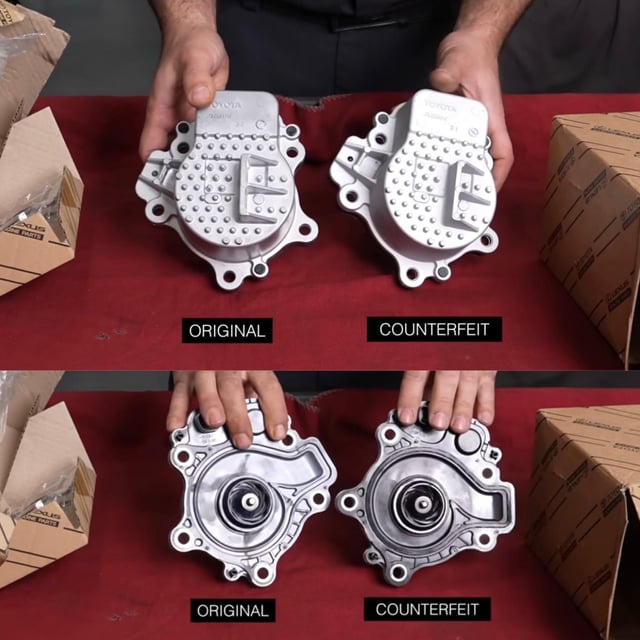
Electric water pumps
This one matters a lot on hybrids like the Prius and RAV4 Hybrid, where the electric coolant pump keeps the hybrid system and inverter from cooking themselves. A genuine Toyota/Denso electric water pump uses a long-life brushless motor rated for the life of the car. The fakes we have seen cut every corner: cheap cast aluminum with a shiny finish instead of the genuine matte casting, sloppily machined O-ring channels that weep coolant, and a cheap brushed DC motor that will not go the distance. Worse, a counterfeit pump often cannot report the correct speed back to the computer. When the car commands the pump and the pump does not spin fast enough, the hybrid computer sets code P0C73 — Motor Electronics Coolant Pump “A” Control Performance. On Toyota, that code triggers when pump speed stays at roughly 1,000 rpm or below for half a second or more during a drive command. A genuine pump does not do that. A cheap fake does it on day one.
Spark plugs
Denso and NGK spark plugs are the most counterfeited parts in the whole category. The danger here is brutal: on a fake plug the ground electrode can break off and drop into the cylinder, and once a chunk of metal is bouncing around between the piston and the head, you are looking at a destroyed engine. A set of “Denso” plugs at a suspiciously low price is one of the riskiest gambles you can take.
Fuel pumps and injectors
These are precision parts. A counterfeit fuel pump or injector is machined to looser tolerances, so it leaks or delivers the wrong pressure. Best case, the car stalls and runs rough. Worst case, a fuel leak under the hood finds an ignition source. This is exactly the kind of part the counterfeit Denso box below (on the left) was built to sell — put it next to a genuine Denso box and the differences start to show.
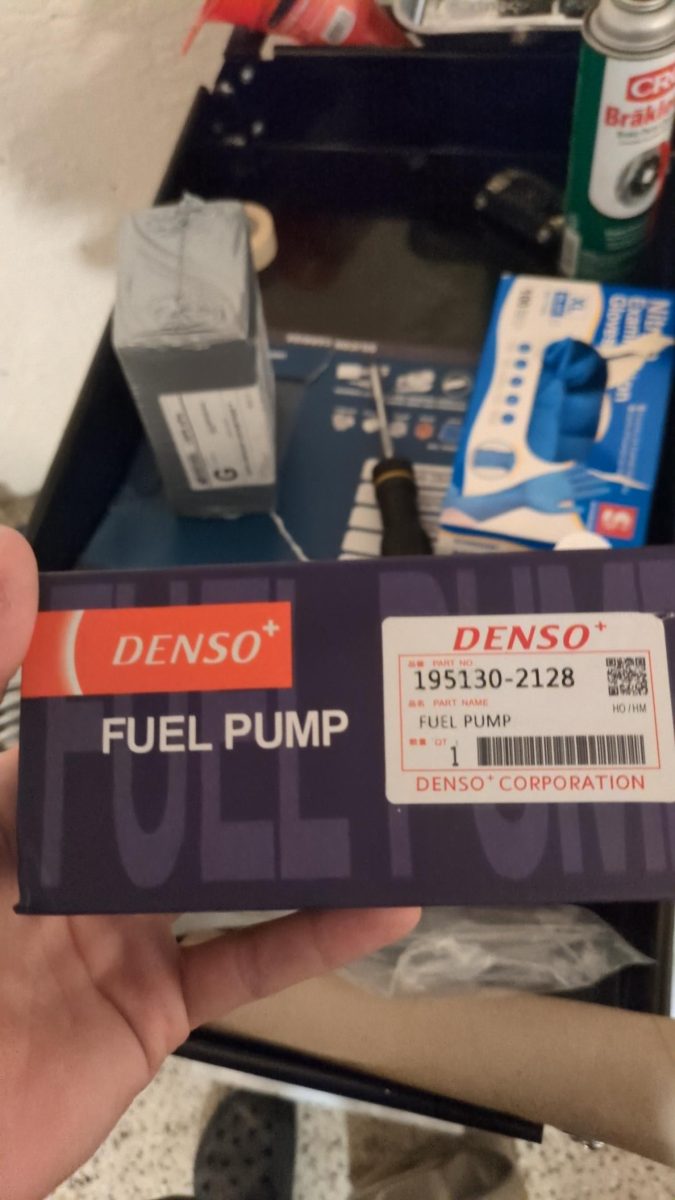
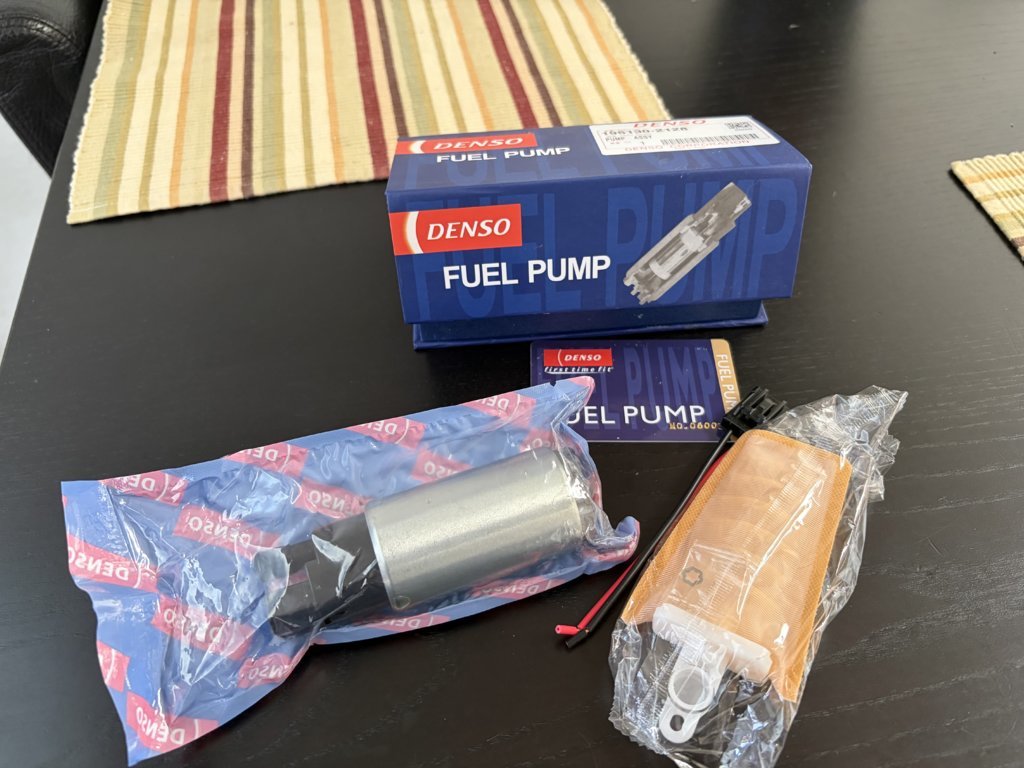
Counterfeit (left) versus genuine Denso (right). Look at the print sharpness, logo crispness, hologram, and batch codes — the fakes fall apart under a close look.
Mass airflow (MAF) and oxygen (O2) sensors
These fakes are sneaky because they look identical to the real thing. The problem is inside: they send the computer the wrong voltage signal. You do not get a part that fails outright — you get one that quietly ruins your fuel economy, and a bad air-fuel ratio can run hot enough to melt your catalytic converter. Now the cheap sensor has cost you a converter too.
How to read the box: packaging tells
Packaging is where counterfeiters make their biggest mistakes, because the anti-counterfeit features on genuine Toyota and Denso boxes are expensive and hard to fake cheaply. Here is a side-by-side of what we check.
Genuine vs. Counterfeit: reading a parts box
The tells we check on a Toyota / Denso box before the part goes on your car
WHAT TO CHECK
✓
GENUINE
✗
COUNTERFEIT
Logo & lettering
Crisp oval logo; correct font, spacing and
stroke weight.
Logo subtly off; odd phrasing like “USE FOR
JAPANESE CAR.” The “5% screen”
Faint dot shading on alternating
logos (Japan-made).
Solid, flat ink — no faint screen
at all.
Hologram sticker
Shifts color & pattern cleanly
when tilted.
Flat, dull, or the layers look
misaligned. Part-number label
“MADE IN JAPAN,” uniform factory batch codes.
Mismatched or blurry codes inside one box.
QR / barcode
Scans to the maker’s official
verification page.
Won’t scan, or leads to a dead page. Print & card quality
Consistent color, sharp print, sturdy
fiberboard.
Distorted letters, off colors, flimsy card.
Source: Toyota “Anti-Counterfeit Campaign — How to Detect a Counterfeit Part.”
Atomic Auto — hybrid & EV specialists, Portland OR — atomicauto.com
The “5% screen” on genuine Toyota boxes. Genuine Toyota fiberboard packaging for parts made in Japan carries a subtle 5% screen — a faint dot-matrix shading on alternating logos or backgrounds. It is deliberately hard to reproduce, so counterfeiters usually print solid, flat ink instead. If every logo is a hard, uniform block of color with no faint screening, be suspicious.
Hologram behavior. Genuine Toyota and Lexus security stickers and holograms shift cleanly in color and pattern when you tilt them in the light. Fake holograms are usually printed on ordinary foil — they look flat and dull, do not change the way they should, or the layers look slightly misaligned. If the sticker looks “printed” rather than alive, that is a flag.
Font and logo anomalies. Fakes frequently get the Toyota logo subtly wrong — the thickness of the inner ovals is off, or the font on the part-number label is not quite right. You will also sometimes see strange English on counterfeit boxes, phrasing like “USE FOR JAPANESE CAR,” the kind of wording Toyota simply does not print. When the text feels “off,” trust that instinct.
Batch code inconsistencies. Genuine multi-packs — a box of spark plugs, a case of oil filters — carry uniform factory batch codes. Counterfeits are often assembled from mixed stock, so you will find mismatched codes inside the same sealed box. Line them up and check.
QR and barcode scanning. Genuine codes scan and link to the manufacturer’s official verification system. Fake QR codes often do not scan at all, or lead to a dead page. If the code is decorative, it is not doing its job — and neither is the part.
Toyota publishes its own guide to these packaging tells. For the official version, see Toyota’s Anti-Counterfeit Campaign: How to Detect a Counterfeit Part (PDF).
The physical inspection
Once the box is open, the part itself tells the rest of the story.
Build quality. Genuine Toyota and Denso parts have clean welds, no burrs on the metal edges, and flawless plastic seams. Counterfeits tend to feel a little lighter in the hand and show rough, unfinished edges, casting flash, or sloppy seams. If you have the old part or a known-good one to compare against, the difference is usually obvious side by side.
The price trap. This is the single most reliable warning sign. If a genuine Toyota part or a Denso sensor is 50 to 70 percent cheaper than the dealer or a legitimate distributor charges, it is almost certainly counterfeit. Nobody sells the real thing at a loss. When the deal looks too good to be true, it is not a deal — it is a fake.
How to protect yourself
The good news is that avoiding counterfeits is mostly about where you buy, not detective work.
Buy directly from a dealership parts counter or an authorized Denso distributor. On marketplaces like Amazon and eBay, read the seller line carefully: a listing marked “Ships from and sold by” an unknown third party is where the risk lives, even if the listing shows the brand name and photos. “Fulfilled by Amazon” does not mean Amazon vouched for authenticity — it just means Amazon warehoused it. When in doubt, go to the source.
And if you would rather not gamble at all, that is where we come in. At Atomic Auto we source genuine Toyota and Denso parts through proper channels, so the parts going into your car are the real thing — with the warranty and the reliability that come with them. If you have already bought a part online and want a second set of eyes before it goes on your car, bring it in. We are happy to look it over. Schedule a visit or give us a call →
Frequently asked questions
Are counterfeit auto parts really dangerous, or just lower quality?
Both. They are lower quality, and that lower quality creates real safety risks — spark plug electrodes breaking off into a cylinder, fuel components leaking, sensors running the engine hot enough to damage the catalytic converter. Unlike a knock-off consumer product, a fake auto part can cause engine failure or a fire.
How can I tell if a Toyota or Denso part is counterfeit before I install it?
Check the packaging first: look for the faint 5% screen on genuine Toyota boxes, a hologram that shifts color cleanly when tilted, correct logos and fonts, matching batch codes inside multi-packs, and a QR code that scans to the manufacturer’s site. Then inspect the part for clean welds, no burrs, and proper weight. A price 50–70% below the dealer is a major red flag.
Is it safe to buy Toyota and Denso parts on Amazon or eBay?
It can be, but only if you are careful about the seller. Parts sold and shipped directly by the manufacturer or an authorized distributor are generally fine. Listings “sold by” unknown third parties are where most counterfeits enter, even when the brand name and photos look legitimate.
My car threw a P0C73 code after a water pump replacement — could the pump be fake?
It is worth checking. P0C73 (Motor Electronics Coolant Pump “A” Control Performance) sets when the electric coolant pump cannot spin up and report proper speed to the computer. Counterfeit pumps with cheap brushed motors commonly cause this, sometimes right away. Bring it in and we can verify the part and the code.
Why would a counterfeit sensor hurt my gas mileage?
Fake MAF and O2 sensors look identical but send incorrect voltage signals to the computer. The engine then runs on bad information, which wastes fuel and can create an air-fuel mixture hot enough to damage the catalytic converter.
Related reading
- Toyota Prius P148F00 Code Explained — what it means when the Prius electric water pump over-revs, the same part counterfeiters copy most.
- Toyota Prius P0A93 Code Explained — the inverter coolant pump code, another pump you want a genuine part for.
- Toyota Prius Catalytic Converter Theft: Which Years Are Targeted, and How a Cat Shield Helps — protecting the converter that a bad counterfeit sensor can ruin.
Questions about your car? Text us at 503-969-3134 — it’s the fastest way to reach us.
About the author: Travis Decker is the owner of Atomic Auto in Portland, Oregon, and an ASE Master Technician (L1, L3). Atomic Auto specializes in Toyota, hybrid, and EV service and uses genuine Toyota and Denso parts sourced through authorized channels.