
Prius ABS Pump Running All the Time? What’s Leaking in Your Gen 2 or Gen 3
Open the driver’s door of a Prius and you’ll often hear a buzz from under the hood. That’s the brake pump, and it’s supposed to do that. What brings these cars to us is when the buzz changes. It runs longer. It comes back every few seconds while the car sits still. Then the brake, ABS and VSC lights come on, and sometimes a buzzer that won’t stop.
Owners call it “the ABS pump.” On a Gen 2 Prius (2004–2009) and a Gen 3 (2010–2015), it usually means the same thing: brake fluid is leaking inside the system, where you can’t see it. First, how the system works. Then the leak makes sense.
How the Prius brake system works
The Prius brakes get their power assist from brake fluid under pressure. Toyota’s owner’s manual puts it in one line: the system “uses brake fluid pressurized by the pump to power-assist the brakes.”
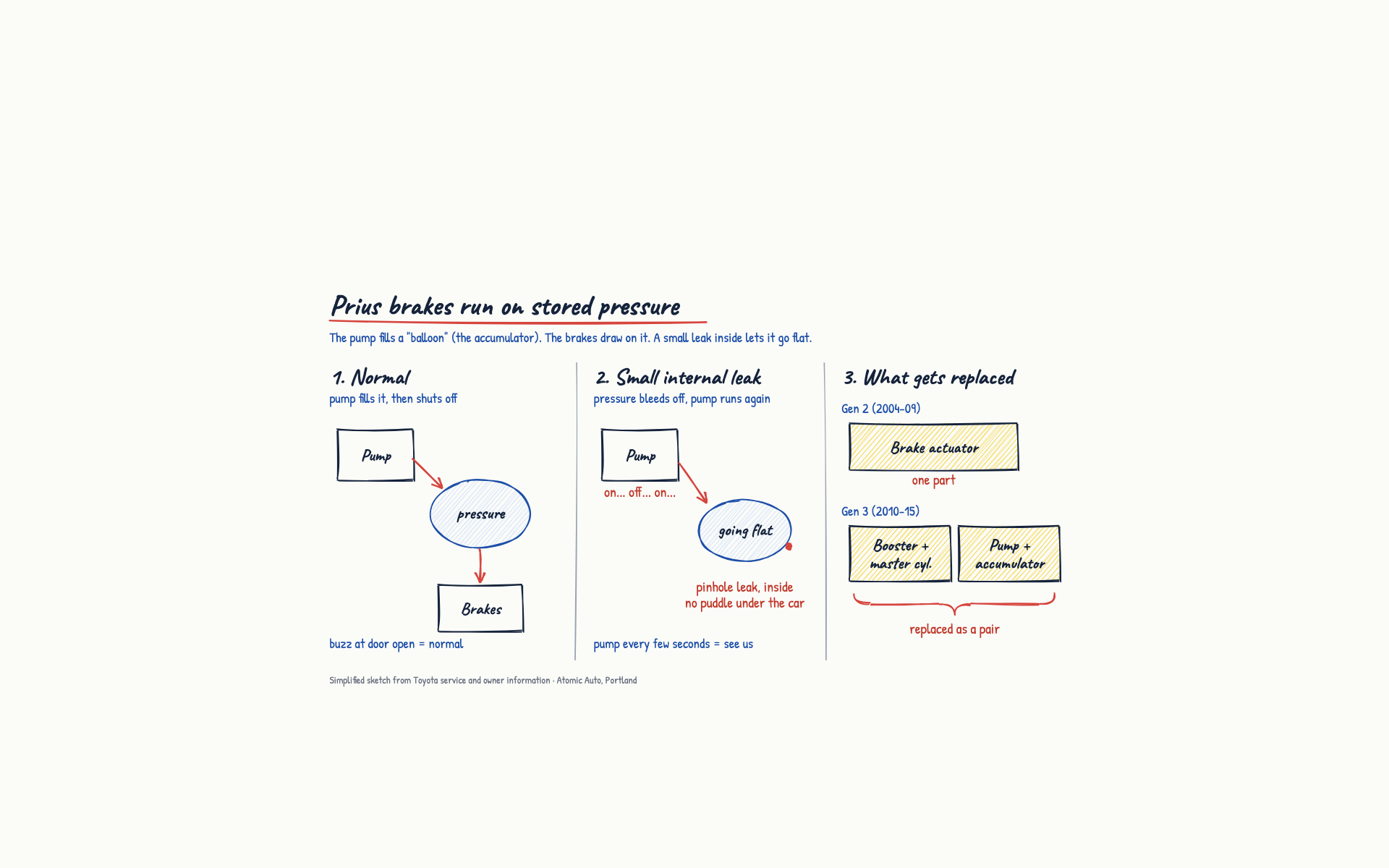
Here’s how we explain it at the counter. Picture a balloon full of brake fluid. An electric pump fills the balloon. Your brakes draw on it every time you press the pedal. Toyota calls the balloon the accumulator, and its description matches: fluid from the pump “is then stored in the accumulator,” and that stored fluid “provides the hydraulic pressure that is needed for brake operation.”
A pressure sensor watches the balloon. When the pressure drops, the brake computer turns the pump on to fill it back up, then turns it off. That on-and-off is the buzz you hear.
So some pump noise is normal. Toyota lists when to expect it: when you open the driver’s door with the car off, when you press the brake pedal with the car off, right after you turn the car on, when you press the pedal over and over, and after you turn the car off.
What an internal leak does
Now poke a pinhole in the balloon. The pressure bleeds away, so the pump turns on to fill it. It bleeds away again, and the pump runs again. A small leak inside the brake unit means the pump runs much more than it should, sometimes every few seconds. Nothing drips on the ground, because the leak is inside the unit.
Toyota describes this in its service bulletins for both generations. The warning lights “may be caused by a small internal brake fluid leak.” The codes that usually come with it:
- C1391: abnormal leak in the accumulator.
- C1256: accumulator low pressure.
- C1252: the pump motor has been running too long.
- C1253: a problem in the pump motor circuit.
Those codes tell us where to look. We still test, and Toyota agrees: if a car doesn’t match the bulletin, keep diagnosing.
Is it safe to drive?
If the red brake light is on and the buzzer sounds without stopping, don’t drive it. Toyota’s manual says that in this case “the brakes may not work properly,” and to stop the car and call for help. Have it towed.
A pump that cycles a lot with no warning lights yet isn’t an emergency. But it is a warning. Here’s how one of our techs put it on a 2010:
The ABS pump is cycling trying to maintain a steady pressure in the unit. Continuing to drive as-is could result in significantly reduced brake function which could potentially cause an accident.
Gen 2 Prius (2004–2009): one part
On a Gen 2, Toyota treats the brake hydraulics as one part, the brake actuator. When the pump runs too long, Toyota’s repair manual points at that assembly. On estimates you’ll also see “ABS pump assembly,” “ABS unit,” or “ABS hydraulic control unit.” Same part.
Toyota’s Gen 2 bulletin covers 2004–2009 Prius and the 2006–2007 Highlander Hybrid, and its repair is one step: “Replace the brake actuator with the NEW part.” After the new unit is in, we bleed the brakes, run the setup with the scan tool, clear the codes, and test-drive the car. (The Highlander Hybrid has its own version of this story. We wrote it up in Highlander Hybrid brake assist failure.)
Gen 3 Prius (2010–2015): two parts
On a Gen 3, the system is two parts. One is the brake booster with master cylinder. The other is the brake booster pump assembly, which Toyota’s own documents label with the accumulator: the pump and the balloon.
Toyota’s bulletins for the 2010 and the 2011–2015 Prius name the same leak, “inside the brake booster assembly with master cylinder.” Then they replace both parts: “the brake booster assembly with master cylinder and the brake booster pump assembly with NEW parts.”
Owners ask us why both, when the leak is in one. Toyota doesn’t publish a reason. Ours is simple: these two parts work as one system. The pump fills the balloon, and the booster uses it. A leak in one puts the other to work. Toyota replaces them as a pair, and so do we. That’s what our Gen 3 repair orders show: both assemblies, then a brake bleed, calibration, cleared codes, and a road test.
Four cars from our shop
The noise was there before the lights
This 2010 came in with the ABS, skid control, brake and check engine lights on, and code C1391. With the car parked, our tech could hear it:
I can hear the ABS pump turn on and run every few seconds. Performed a visual inspection of the brake system and I do not see any visual leaks.
The owner told us the noise started before the lights did. They’d had the brakes replaced elsewhere, but the noise stayed. About a month later, the lights came on. New pads don’t stop a pump from chasing a leak.
We tried the cheaper fix first: bleed the system and redo the calibration. The car reported the calibration as done, and the codes came right back. So we replaced both assemblies, cleared the codes, calibrated, and bled the system. No lights came back.
A warning on one visit, a failure on the next
This 2009 first came to us with C1256, accumulator low pressure, stored. The pump wasn’t acting up yet. Four months later, the car came back with a dead 12-volt battery and the same code. This time the pump was running:
It wasn’t doing it the last time in, but the ABS unit pump has now started cycling, indicating that an internal leak is present. This causes the loud beeping noise that client described.
We replaced the brake actuator and bled the system. A stored C1256 with no symptoms is worth watching. It doesn’t fix itself.
The plain-English version
A 2010 with multiple warning lights and C1391. Our tech’s note to the owner was short and clear: an internal leak, a pump working to keep up, and a recommendation to fix it soon or stop driving. We replaced both assemblies, bled and initialized the system, and the codes stayed gone on the road test.
The leak you could see
Not every brake leak is internal. This 2009 came in with the ABS, brake and VSC lights on and C1256. Under the car, our tech found brake fluid. Up top, the brake actuator showed signs that someone had already been in there:
There is paint pen on the unit. Appears someone has been in here already. The line that goes into the top of the unit appears to be leaking. It also does not look like it went in straight which could mean that the line is cross threaded.
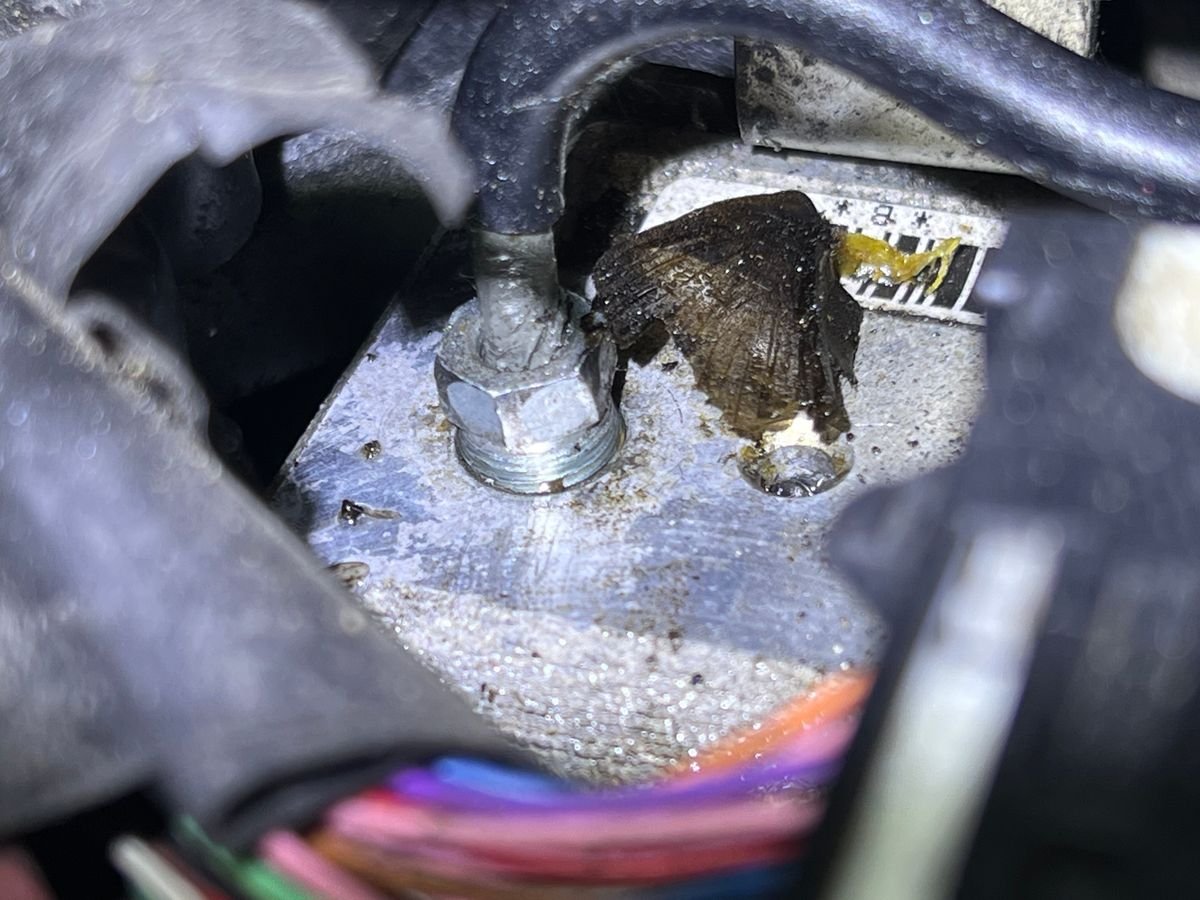
We replaced the brake actuator, bled it, and calibrated it to the car. When we see a leak like this, we look at the fittings and lines before we price anything, because a cross-threaded line can mean more parts.
Why we install new Toyota parts
Used units are no longer a repair option for us. We also haven’t found rebuilt units that meet our standards at the price they ask. So we use new Toyota assemblies. The part is only half the job. Bleeding, setup, calibration and a road test are what make the brakes right afterward.
Is the repair free? Check before you assume
Toyota ran a customer support program for the Gen 3 parts, called ZJB. It covered the brake booster and the brake booster pump for “10 years from the date of first use, or 150,000 miles whichever occurs first.” Most Gen 3 cars are now past ten years, so most are no longer covered. If yours is close, have a Toyota dealer check your VIN before you pay anyone, including us.
A service bulletin by itself is not a promise of a free repair. It tells technicians how Toyota wants the condition fixed.
What this means for you
If your Prius pump buzzes more than it used to, note when it runs. Does it run with the car parked? Every few seconds? Does the brake pedal feel different? Those answers help us find the leak fast. If the red brake light and a nonstop buzzer come on, stop driving and tow it.
Hybrid brakes wear differently, too, so the 4mm brake pad rule doesn’t apply to them. We test before we sell anyone a part; this is how we diagnose Toyota hybrid problems. Every code we’ve written up is on our Toyota hybrid and EV trouble codes page. Shopping for a Prius? Get a pre-purchase inspection first.
Frequently asked questions
Is the Prius brake pump supposed to make noise?
Yes, at certain times. Toyota says you may hear it when you open the driver’s door, press the brake with the car off, or turn the car on or off. A pump that runs every few seconds with the car parked is not normal.
Why does a Gen 3 Prius need two brake parts replaced?
Toyota’s bulletins call for replacing the brake booster with master cylinder and the brake booster pump together. Toyota doesn’t publish why. The two parts work as one system, so we replace them as a pair too.
Can I keep driving with the ABS pump running a lot?
If the red brake light and a continuous buzzer are on, no. Toyota says the brakes may not work properly. If the pump is just cycling more than before, get it checked soon. It usually gets worse, not better.
Questions about your car? Text us at 503-969-3134 - it’s the fastest way to reach us.
About the author: Travis Decker is the owner of Atomic Auto in Portland, Oregon, and an ASE Master Technician (L1, L3). Atomic Auto specializes in Toyota, hybrid, and EV service.
General information from the cars that come through our bays. Yours is its own case, and we would rather test it than guess.
Text us, or book a slot.
A text with a photo of the dash gets you an answer fastest. Booking online holds a day and a time.