
Prius P0420 Code: Is It Really the Catalytic Converter?
P0420 is the code that sends a lot of Portland Prius owners to us right before DEQ. The scan tool says the catalytic converter isn’t doing its job. Sometimes that’s exactly right. Sometimes the converter is fine and something else is fooling the computer. And sometimes someone has already tried to fool it on purpose.
First, how your Prius decides the converter is worn out. Then what Toyota says to check, and three cars that each had a different answer.
How your Prius grades its catalytic converter
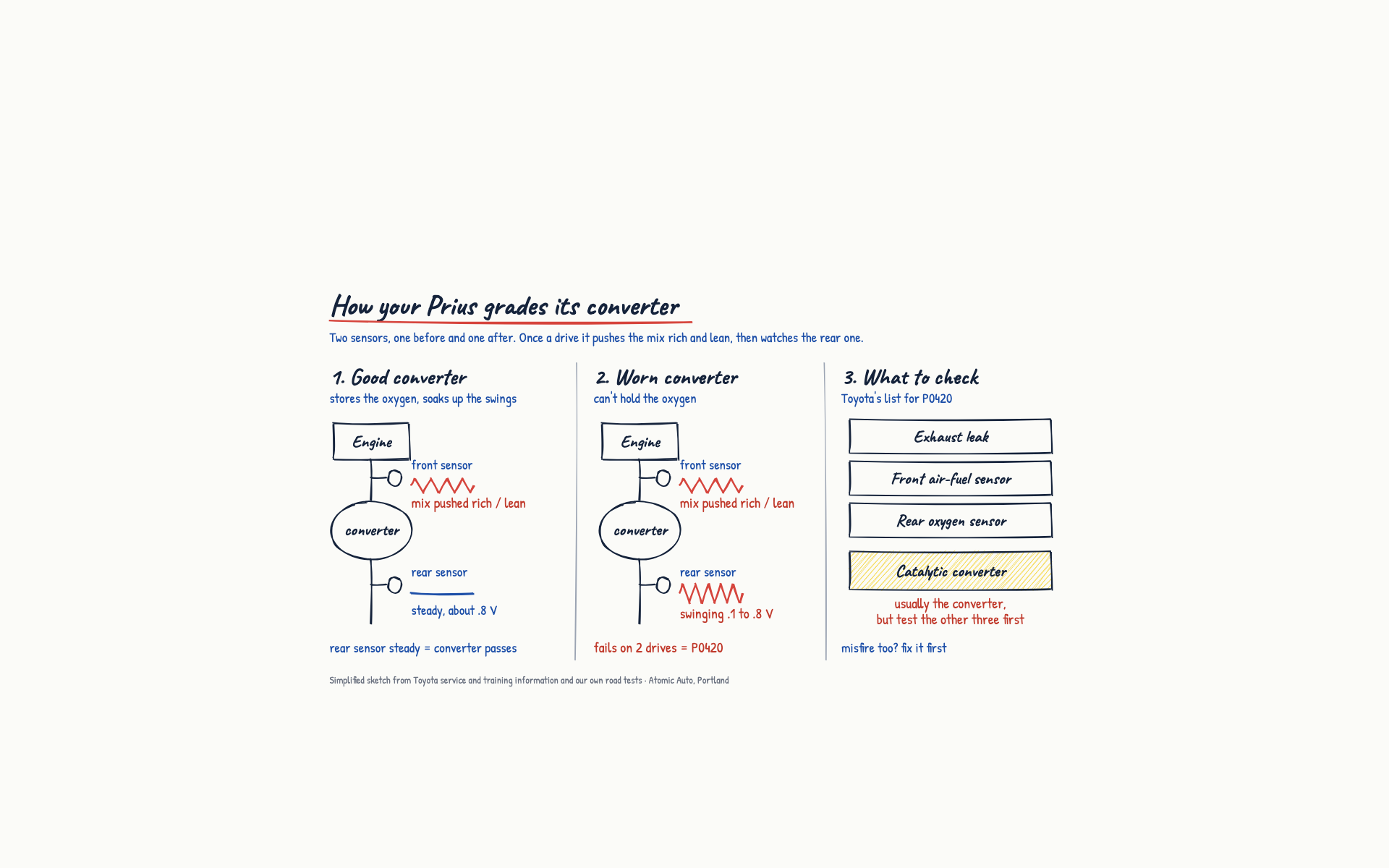
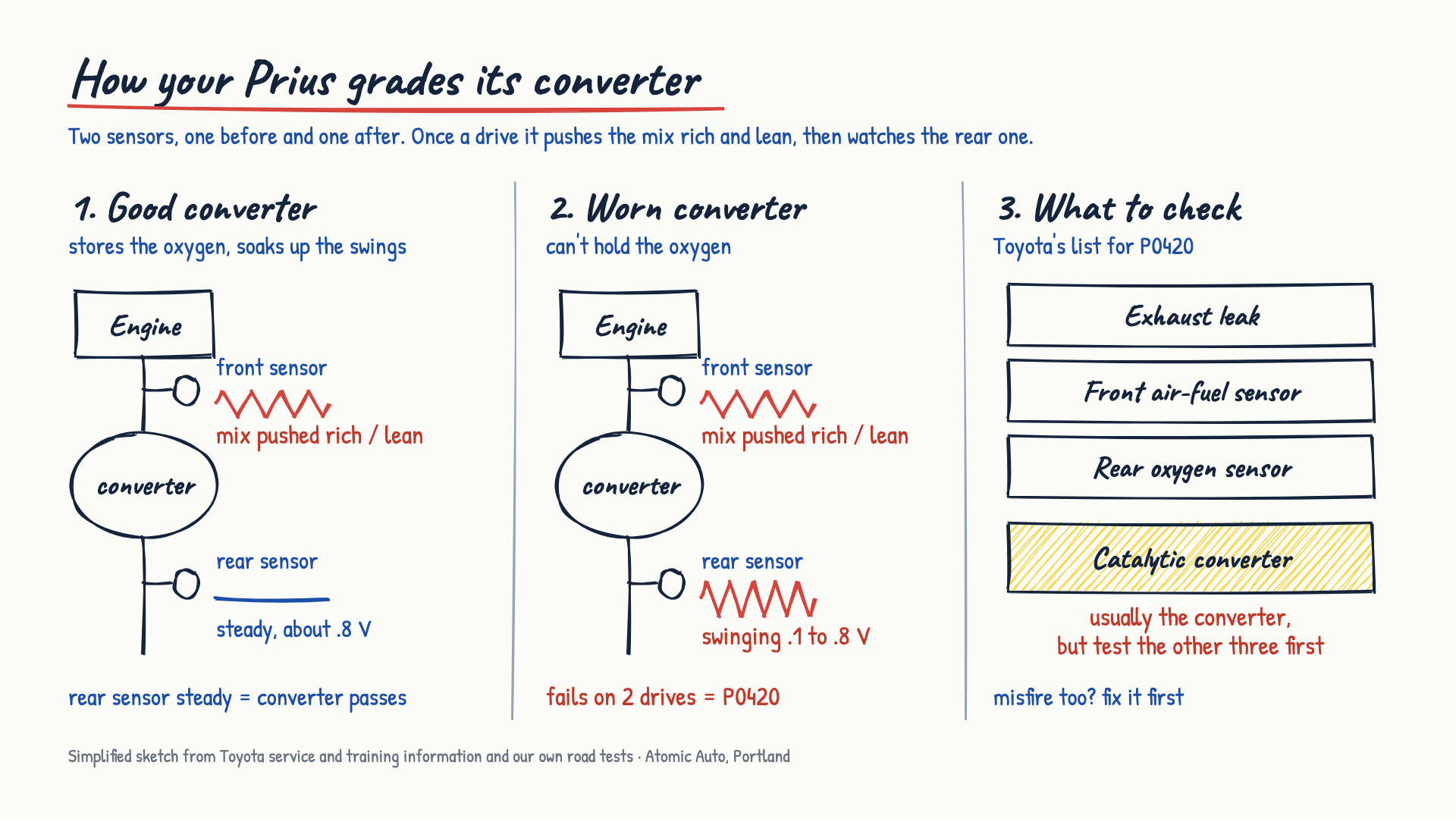
Your Prius has two exhaust sensors. One sits before the catalytic converter and one sits after it. Toyota’s repair manual says the engine computer uses those two sensors to monitor how well the converter is working.
A healthy converter stores oxygen and lets it go as the engine runs a little rich, then a little lean. So once a drive, with the engine warm, the computer runs a short test. It pushes the fuel mixture rich and lean on purpose and watches the rear sensor. A good converter soaks up those swings, and the rear sensor stays steady. A worn converter can’t hold the oxygen, so the rear sensor starts swinging too. Toyota calls what’s being measured the converter’s oxygen storage capacity. When it falls below Toyota’s limit, the computer sets P0420.
Our techs check this the same way on a road test. One of them wrote it down better than we could:
The value should stay ~ .8 volts at a steady cruise. Voltage is swinging from .1 to .8 volts intermittently, which indicates that the catalytic converter is failing.
The light doesn’t come on the first time the test fails. Toyota sets P0420 as a two-trip code, so the converter has to fail on two separate drives.
What Toyota says to check
Toyota’s full name for the code is “Catalyst System Efficiency Below Threshold (Bank 1).” Its repair manual lists four places the problem can be:
- The catalytic converter itself
- An exhaust leak
- The front air-fuel ratio sensor
- The rear oxygen sensor
Toyota’s own training says the converter is the likely answer once the sensors and fuel trims check out and the code keeps coming back after it’s cleared. That’s why we test those things first instead of quoting a converter off the code alone.
What we usually find
Most of the time, it really is the converter. On a lot of the Priuses we see with P0420, it isn’t the converter Toyota put there. Thieves go after the Gen 2 Prius converter more than most, and plenty of these cars got a replacement converter after a theft. Some of those replacements don’t last.
Here are three that each needed something different.
Three cars, three different fixes
The converter the insurance company bought
This Prius came in with the check engine light on and its registration due. P0420 was back. The car’s history explained why:
The original equipment Toyota catalytic converter was previously stolen, 8-14-2020. Per the insurance company, an aftermarket catalytic converter was installed instead of an original equipment CARB approved catalytic converter.
The replacement had already worn out. Our recommendation was short:
Recommend an original equipment Toyota catalytic converter be installed.
Toyota’s warranty guide makes the same point in its own words: parts “not equivalent in quality to Genuine Toyota Parts may impair the effectiveness of the emission control systems.” A cheap converter can turn the light off for a while. It may not keep it off.
The misfire came first
This 2005 Prius came in stuttering on acceleration with P0420 and a cylinder 1 misfire, P0301. Before touching the converter, our tech went after the misfire:
Removed cylinder 1 ignition coil and found that the spark plug tube was half filled with water.
The drain in the cowl, the panel at the base of the windshield, was clogged. Rain was spilling into the spark plug area. We cleaned out the drain, the tube, and the coil, and the misfire was gone.
Then the converter. It was an aftermarket unit, and the rear sensor test above is from this car. It was swinging. We replaced the converter and ran the same test again:
Voltage stayed at ~ .8 volts for the duration of the road test.
Fixing only the converter on this car would have left the water problem in place. Fixing only the misfire would have left P0420. It needed both.
The part that hid the code
This Prius came in with the check engine light on for a misfire and a computer fault. Another shop had told the owner it was an oxygen sensor. Under the car, our tech found something else:
Inspected and found that the rear oxygen sensor wiring is jammed into the vehicles body due to an anti-fouler installed between the cat and the sensor (see pictures). These are installed to trick the ECU into seeing a normal signal from the rear sensor due to a bad cat.
An anti-fouler is a spacer that sits between the converter and the rear sensor. As our tech’s note says, it’s there to trick the computer. It doesn’t fix anything. It hides the problem until the next inspection, or the next shop.
Our plan was to take the spacer out, put in a new rear sensor, clear the codes, and see what came back. Our tech expected P0420. If you’re buying a used Prius, that’s one more reason to have someone look under it. Here’s our guide to buying a used Prius.
P0420 and Oregon DEQ
DEQ is clear about the light. Its own page says that if the check engine light is on, the car “will not pass the emissions test.”
The car also has to finish its own self-tests, which DEQ calls monitors, before it can be tested. DEQ’s rule is stricter for a car that already failed for a converter code: on the retest, the converter monitor has to be finished. So the car has to run its converter test again, and a worn converter will just fail it again and set the code.
We run DEQ tests here. If you want to know where you stand before your registration is due, see our DEQ Too page.
What this means for you
If your Prius has P0420, the converter is the most likely answer. But check the other three things on Toyota’s list before you buy one. A shop with a good scan tool can watch the rear sensor on a road test and tell you whether the converter is really worn. If there’s a misfire, fix it first.
If your converter was stolen and replaced, find out what went in. A replacement that’s already failing may still be under that shop’s warranty. Our catalytic converter theft guide covers which years get hit and how a shield helps.
It’s the same test-first order we use on other warning lights. Here’s how we diagnose Toyota hybrid problems. Every code we’ve written up is on our Toyota hybrid and EV trouble codes page.
Frequently asked questions
Is P0420 always the catalytic converter?
Usually, but not always. Toyota also lists an exhaust leak, the front air-fuel ratio sensor, and the rear oxygen sensor. We’ve also found misfires that needed fixing first, and a spacer someone added to hide a bad converter.
Can I clear P0420 and pass DEQ?
Not for long. After a converter failure, DEQ wants the car’s own converter test finished on the retest, and a worn converter will fail that test and set the code again.
My converter was stolen and replaced. Why do I have P0420 now?
We see it often. Some replacement converters don’t hold up the way the original did. Have the converter tested, and check whether the shop that put it in offers a warranty.
Questions about your car? Text us at 503-969-3134 - it’s the fastest way to reach us.
About the author: Travis Decker is the owner of Atomic Auto in Portland, Oregon, and an ASE Master Technician (L1, L3). Atomic Auto specializes in Toyota, hybrid, and EV service.
General information from the cars that come through our bays. Yours is its own case, and we would rather test it than guess.
Text us, or book a slot.
A text with a photo of the dash gets you an answer fastest. Booking online holds a day and a time.