
Short version: When a Prius or Toyota hybrid won’t start, throws a wall of warning lights, or won’t detect the key fob, it’s almost always the small 12V battery — not the expensive hybrid battery. The 12V only wakes the computers and connects the high-voltage system; once the car is in READY, the DC/DC converter recharges it. Jump it, find what drained it, and let the car sit in READY for 30 to 60 minutes.
Your hybrid won’t start. The dash lit up like a slot machine, the shifter throws a “Park Lock Malfunction,” the key fob won’t do anything, and the car won’t go into READY. Before you panic about a hybrid battery that costs thousands — stop. Nine times out of ten, this is the little 12V battery, and it’s one of the cheapest parts on the car.
The 12V battery isn’t what you think it is
On a Prius — or any Toyota hybrid built on Hybrid Synergy Drive, which is every Toyota hybrid car and crossover — the 12V battery doesn’t crank an engine. There’s no conventional starter motor spinning over. (The one exception in the lineup: Toyota’s i-FORCE MAX hybrid trucks, the Tundra and Sequoia, do use a conventional 12V starter — a different system from the cars.) The 12V battery has one job: wake up the computers and close the big relays that connect the high-voltage hybrid battery. Once the car is in READY, the high-voltage system takes over and a device called the DC/DC converter keeps the 12V system alive — it’s the hybrid’s version of an alternator. It taps the high-voltage hybrid battery (a couple hundred volts DC) and steps it down to about 13.6 volts DC, which is the voltage needed to run the car’s 12V electronics and keep the 12V battery charged. So in READY, the little battery is constantly being topped up. With the car off, there’s no DC/DC converter running, and it’s on its own.
That’s the key thing to understand. The 12V battery is small. It’s not built to run headlights and accessories for long with the car off. It’s built to boot the system and then hand off. When it gets weak or drained, the whole car acts broken even though nothing expensive is wrong.
The symptoms of a weak or dead 12V
In our shop we see the same pattern over and over. A weak 12V looks like:
- The car won’t detect the key fob — you press the button and nothing happens.
- You get a light show — a dozen warning lights, red triangle, master warning, all at once.
- A “Park Lock Malfunction” message on the shifter.
- The car won’t enter READY, or it clicks and quits.
- Power windows, locks, and the dash acting slow or strange.
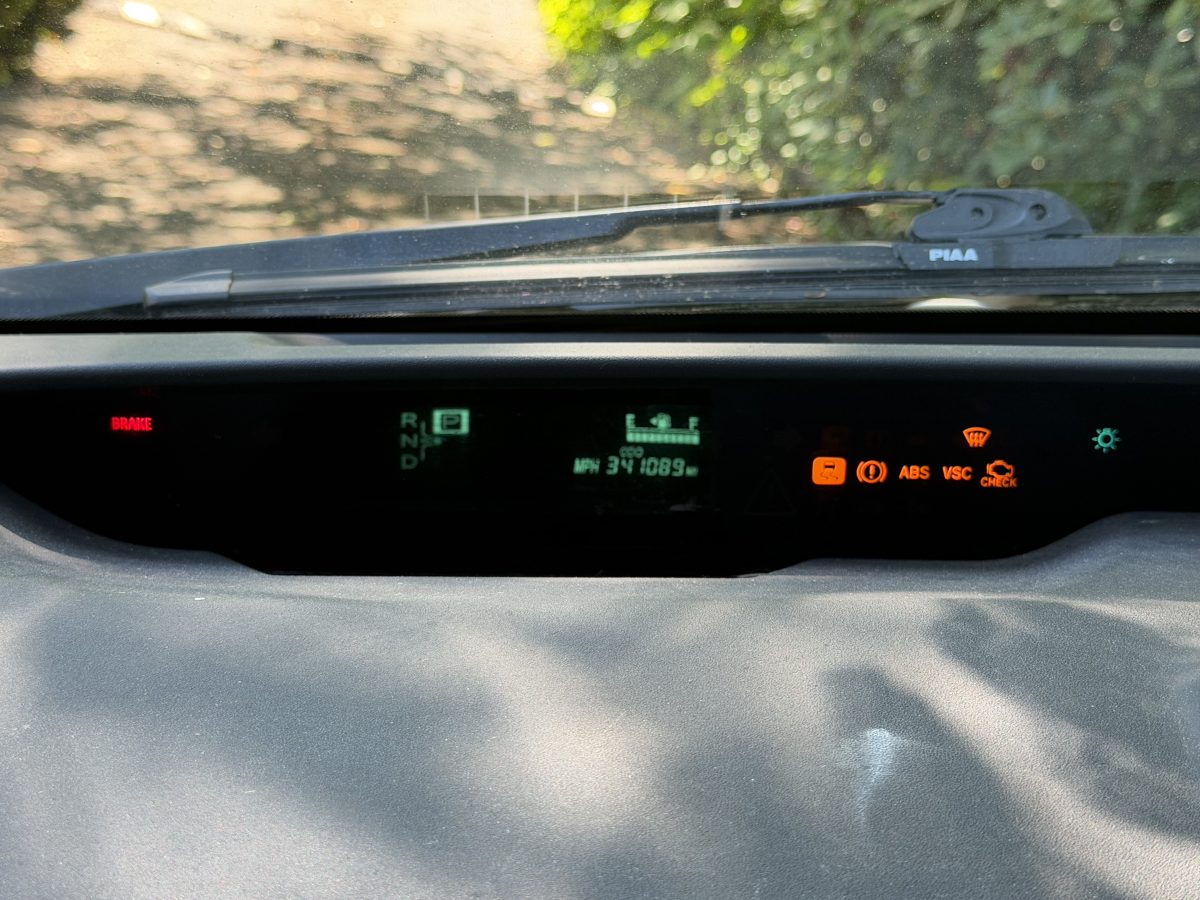
That “Park Lock Malfunction” message throws people. It sounds like the transmission failed. It didn’t. It’s just the computers seeing low voltage and getting scared and confused. Restore good voltage and the message clears on its own. It’s a symptom, not the disease.
How these batteries usually die
Most dead-12V calls we get trace back to a handful of causes:
A bumped map light or dome light. These interior lights pull power the whole time they’re on. Leave one on and the small 12V can be flat in a matter of hours — not days.
A door or hatch left ajar. Same story. If the car thinks a door is open, it keeps systems awake and lights on, and the battery bleeds down fast.
Powering off instead of shifting to Park. This is the big one, and it’s counterintuitive. Say you pull over but you’re not getting out. Most people press the POWER button to shut the car off. The problem: with the car “off” but the driver’s door still closed, the headlights stay on — they only shut off when you open the driver’s door. Sit there for a while and you’ve drained the battery.
If you’re staying in the car, do the opposite: press PARK and leave the car in READY. In READY, the DC/DC converter is actively charging the 12V battery. You can sit as long as you like and the battery stays topped up.
What “READY” actually means
READY is the hybrid version of “the car is running.” On Toyotas, the dash literally shows the word READY. Other manufacturers use a symbol — often a little car outline. It does not mean the gas engine is running; on a hybrid the engine cycles on and off on its own. READY means the high-voltage system is live, the DC/DC converter is charging your 12V, and the car is ready to drive.
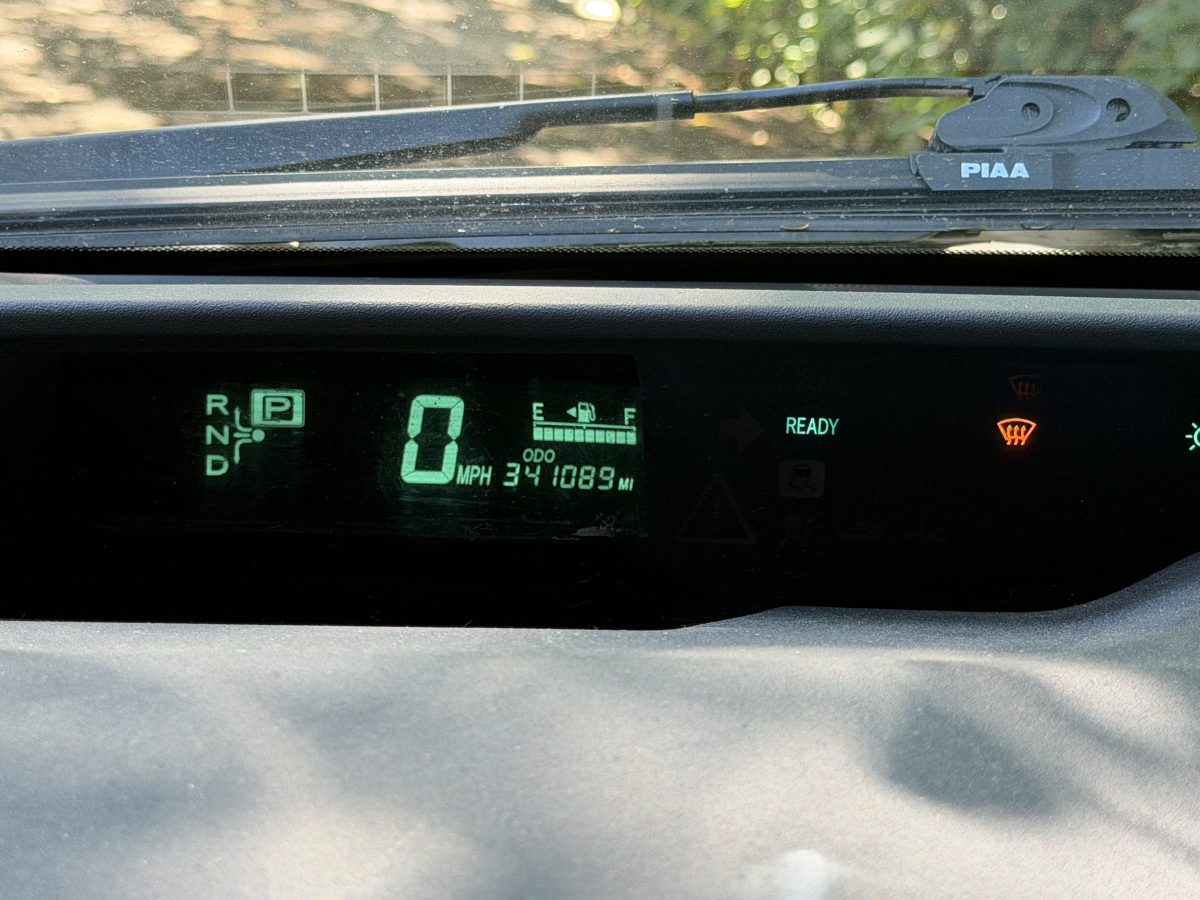
Here’s the practical rule: any time you’re going to sit in the car with things running or a door open for more than a minute or two, keep it in READY — leave the car on and simply shift to PARK. Do not press POWER to shut it off. That covers pulling over to take a phone call, waiting in a pickup line, loading or unloading groceries with the hatch up, sitting with the radio and AC on, or anything that keeps a door ajar or accessories powered for a while. In READY, the car keeps its own 12V topped up and you can’t drain it.
Press POWER OFF in that same situation and you’re now running lights and accessories straight off a small battery with nothing recharging it. Here’s the trap most people don’t know: when you power the car off, the headlights stay on until you open the driver’s door. Sit there with the doors closed and those lights will quietly run a healthy 12V dead in an afternoon. So the rule is simple — if you’re staying in the car, shift to PARK and stay in READY rather than powering off.
If you have to jump it — do it right
A dead 12V will get you a jump, but three things bite people afterward.
First, find what drained it before you drive off. After you jump the car, check that every interior light is off and every door and the hatch are fully closed. If a bumped map light or an ajar door caused it, and you don’t fix that, you’ll be dead again by morning. We’ve had cars come back on a tow truck for exactly this.
Second, let it recharge before you shut it off. A jump only gets the car started — it does not refill the battery. Once you’re in READY, the DC/DC converter recharges the 12V from the hybrid battery, and here’s the part most people get wrong: sitting parked in READY charges the 12V just as well as driving does. The converter’s output is the same either way, so you don’t need to drive around — just leave it in READY. Plan on 30 to 60 minutes, and turn off as many loads as you can — heat, AC, headlights, seat heaters, audio — so more of that current goes into the battery. Do this outdoors: never leave the car in READY inside a garage or enclosed space. The gasoline engine starts on its own, without warning, and the exhaust can fill the space with carbon monoxide. If it was drained completely flat, or this isn’t the first time, give it a few hours, or better, put it on a proper smart charger. And remember, it doesn’t charge at all with the car powered off, so don’t shut it down right after the jump.
Third — never use your hybrid or EV to jump-start another vehicle. The 12V battery is tiny and the DC/DC converter isn’t designed to dump that kind of current into a dead truck. You can strain or damage the converter, and that’s a far more expensive repair than a jump box. Your hybrid is not a jump pack.
For the actual jump-start steps — where the under-hood jump point is, and why you don’t touch the battery in the back — see our step-by-step guide: How to Jump Start a Prius.
Keep a jump box in the trunk
Skip the jumper cables and the awkward flag-down-a-stranger routine. We recommend every hybrid owner keep a small lithium jump box in the car. The NOCO GB40 is a solid, well-priced choice — compact enough to live in the trunk, and it’ll get your hybrid into READY without needing another vehicle. (Heads up: that’s an affiliate link — if you buy through it, Atomic Auto may earn a small commission at no extra cost to you.) Charge it a couple times a year and it’s there when you need it.
Part of why we like it: it’s a smart jump box. It checks the connection before it sends any power, so if you accidentally clamp the leads backward (positive to negative), it simply won’t turn on the boost instead of throwing sparks or damaging electronics. For most dead-12V situations you clamp it on, it confirms a good connection, and you’re in READY in seconds.
One important exception — a fully dead battery and “Manual Override.” The GB40 will only auto-detect and boost a battery down to about 2 volts. If your 12V is completely flat (below 2 volts), the boost light stays off because the box can’t “see” a battery to jump. To force it, use the GB40’s Manual Override button — it’s the one marked with a red exclamation point (!). Press and hold it for about 3 seconds until the charge lights start chasing.
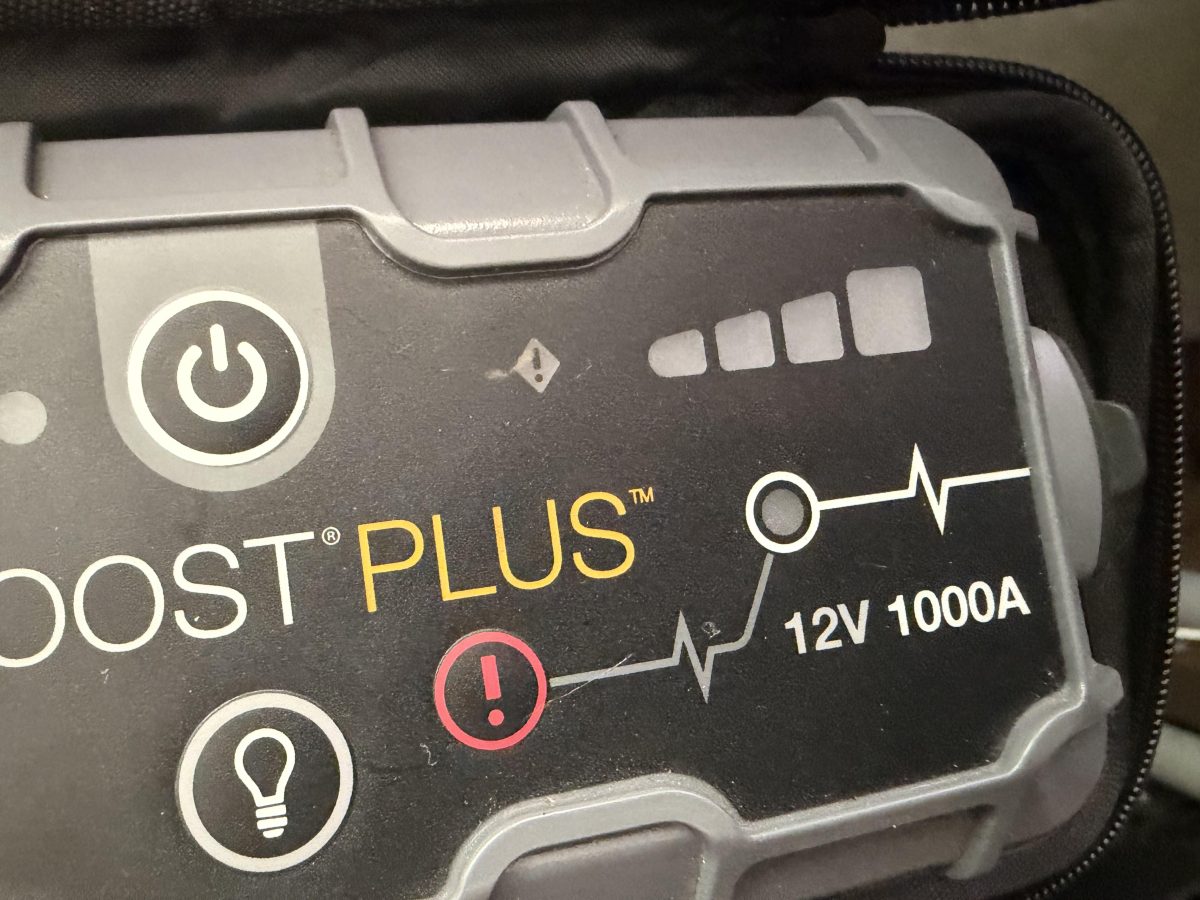
Here’s the catch, and it matters: Manual Override turns off all the safety features — both the spark protection and the reverse-polarity protection. In that mode, if your clamps are backward, nothing stops it. So before you use Manual Override: double-check that red is on positive and black is on the ground/negative, make the connection carefully, and turn the jump box off before you remove the clamps. Used correctly it’ll revive a stone-dead battery; used carelessly it can spark or damage the car. When in doubt, that’s a good moment to call us instead.
“I put in a new battery but it still acts weird”
We hear this one a lot, and it’s usually not the battery — it’s how the battery went in. When AAA or a do-it-yourselfer swaps a 12V, three connections have to be right: the positive terminal, the negative terminal, and the ground strap that bolts to the body. On a hybrid, every one of those is critical. A terminal that’s loose, corroded, or not fully torqued — or a ground strap that didn’t get reattached snugly to the body — leaves the computers seeing weak or noisy voltage.
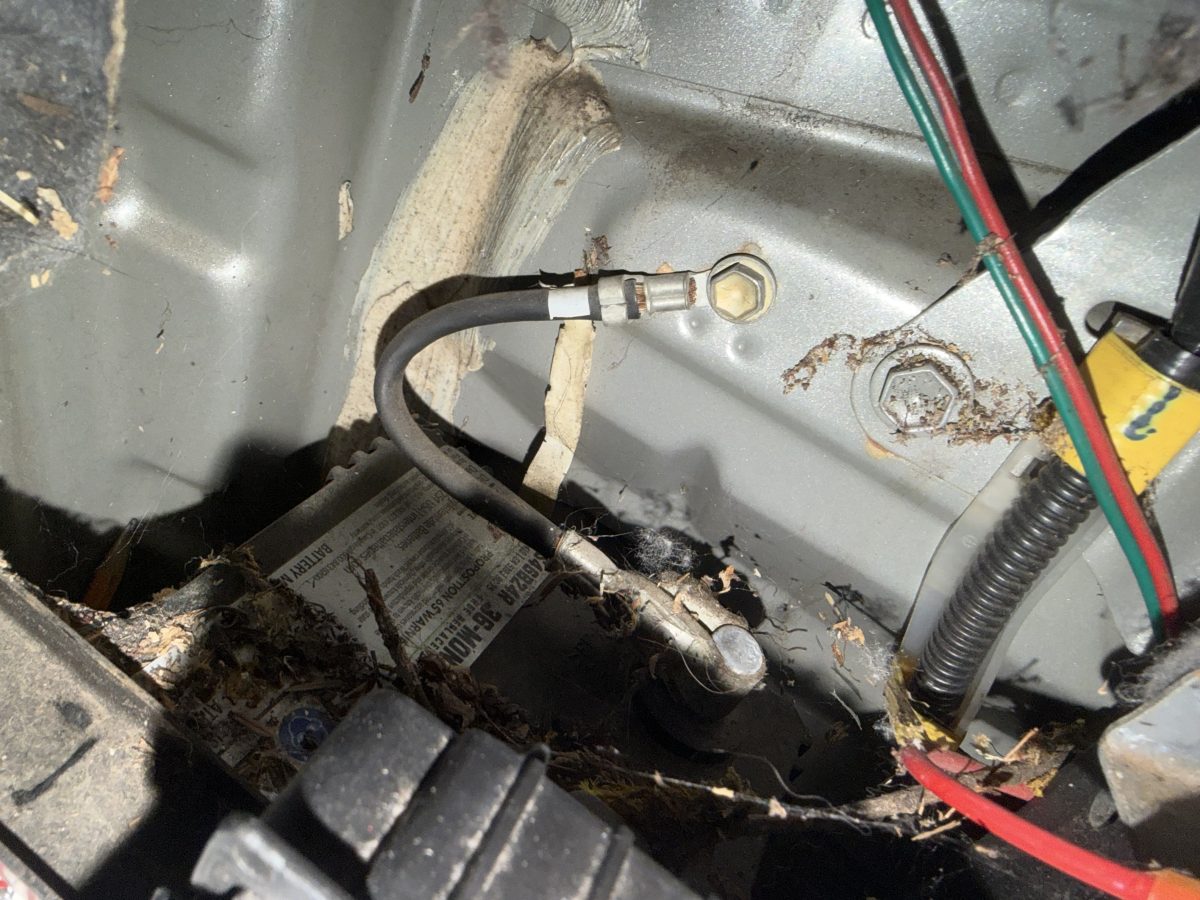
The result is a car with a brand-new battery that still throws odd warning lights, won’t detect the key, drops accessories, or feels generally “possessed.” People assume they got a bad battery or that something bigger is wrong. Nine times out of ten it’s the installation: a connection that’s loose, reversed, or bolted to paint or rust instead of clean metal. If your no-start or gremlins showed up right after a battery replacement, start there — check that all three connections are clean, tight, and in the right place before chasing anything expensive.
Maximizing the life of your 12V
There’s no fixed replacement interval on these — how long yours lasts depends on how the car is used. A few habits stretch it:
- Drive it regularly. A hybrid that sits for weeks slowly self-discharges the 12V. If it’s going to sit, drive it or put a maintainer on it.
- Watch the interior lights and doors. Most “dead battery” no-starts are self-inflicted.
- Use PARK + READY when you’re sitting in the car, not POWER OFF.
- For long-term storage on Toyotas, use the smart key disable button. Toyota’s smart key system constantly listens for the fob, drawing a little power around the clock. A button low on the dash (driver’s left knee) turns that off — pressed in, it’s disabled. Push it in before the car sits and the 12V holds its charge. Heads up: because it’s right by your knee, people bump it in by accident all the time, then can’t figure out why their smart key suddenly stopped working. If your fob quits working wirelessly, check this button first.
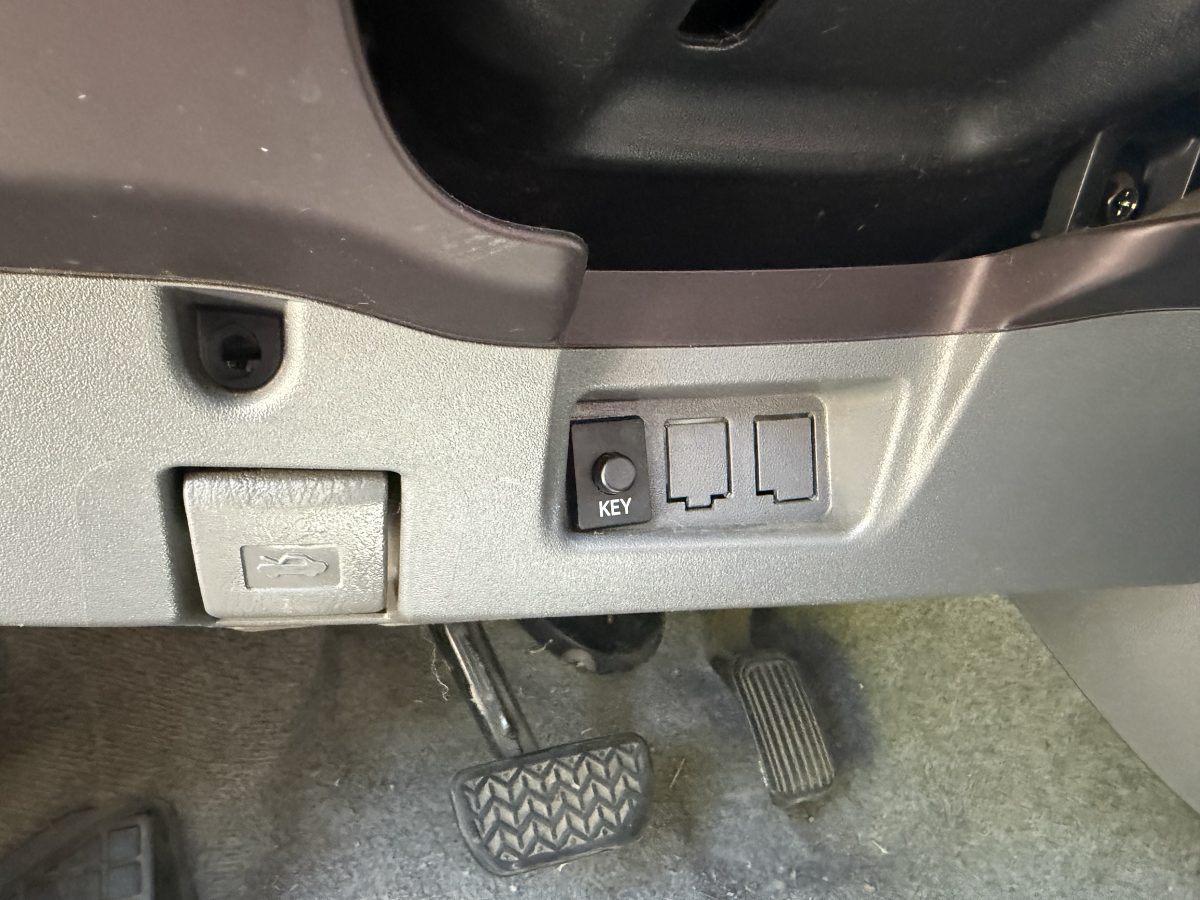
How we catch a weak 12V before it strands you
At Atomic Auto we test the 12V battery as part of every 5,000-mile (intermediate) service. A weak battery gives warning signs on a test bench long before it leaves you stuck in a parking lot, so catching it on a regular visit is the easiest way to avoid the whole ordeal.
If you’re handy, you can watch your 12V yourself. This video shows how to test it in the car: How to test your Prius 12V battery. One caution: if the battery is already weak, the test itself can push it over the edge and leave you needing a jump — and running the test too long can do the same. Keep it short, and if the battery is marginal, let us handle it.
If your Toyota hybrid won’t start, is throwing a wall of warning lights, or won’t detect the key, don’t assume the worst. Bring it in and we’ll test the 12V first — it’s usually the cheap fix hiding behind a scary dashboard.
Frequently asked questions
Is a “Park Lock Malfunction” message serious?
Usually not. It almost always means the 12V battery is weak and the computers are seeing low voltage. Once the battery is charged or replaced, the message typically clears. Get the 12V tested to confirm.
Does a dead 12V mean my hybrid battery is failing?
No. They’re two completely different batteries. The small 12V wakes up the car’s computers; the large high-voltage battery drives the car. A dead 12V makes the car act totally broken, but the hybrid battery is usually fine.
How long should I leave my Prius in READY after a jump start?
Park it in READY for 30 to 60 minutes with the lights and climate control off — outdoors or with the garage door fully open, since the gas engine will start on its own while it charges. Sitting in READY charges the 12V just as well as driving — the DC/DC converter’s output is the same either way, so you don’t need to drive around. If it was fully flat, give it a few hours or use a smart charger. If it keeps needing jumps, the battery is worn out and should be replaced.
How long does a Prius 12V battery last?
There’s no set interval — it depends on use, climate, and how often the car sits. Regular testing (we check it every 5,000-mile service) is more reliable than a calendar.
Can I jump-start another car with my Prius?
No. The 12V is too small and you risk straining the DC/DC converter. Use a proper jump box like a NOCO GB40 instead.
Why did my battery die when I was just sitting in the car?
You probably pressed POWER OFF instead of shifting to PARK. Powered off with the door closed, the headlights stay on and drain the battery. Leave the car in PARK and READY when you’re sitting in it.
Related reading
- Why Your EV Won’t Wake Up: The 12V Battery Explained
- How to Jump Start a Prius (Step-by-Step, All Generations)
- Why Check Hybrid System Doesn’t Always Mean You Need a Hybrid Battery
Questions about your car? Text us at 503-969-3134 — it’s the fastest way to reach us.
About the author: Travis Decker is the owner of Atomic Auto in Portland, Oregon, and an ASE Master Technician (L1, L3). Atomic Auto specializes in Toyota, hybrid, and EV service and has diagnosed thousands of Prius no-start and warning-light problems.