
Short version: Your EV still has a small 12V battery, and when it goes flat the whole car can act dead. The smart key may not unlock the doors, the shifter may not leave Park, and the car may not turn on at all. That is the little battery, not the big one. Get in with the mechanical key, wake the car with a jump box, and never use your EV to jump someone else’s car. Then find out what drained it.
You walk up to your EV and it won’t unlock. Or it unlocks, you sit down, press the brake and the power button, and nothing happens. Maybe it turns on but won’t come out of Park. The first number that goes through your head is the price of a traction battery.
Take a breath. On a hybrid, this exact scene is almost always the 12V battery, and we wrote it up in detail here: Why Your Prius or Toyota Hybrid Won’t Start: The 12V Battery Explained. EVs have the same small battery doing the same job, and the owner’s manuals say so. Nissan’s Leaf manual puts it this way: if the electrical systems won’t turn on, “the 12V battery may be discharged.”
Yes, your EV has a 12V battery
The big traction battery moves the car. The small 12V battery runs the computers, the locks, and the screens, and it has to be alive before the big one can do anything. Nissan explains why a jump start matters on a Leaf: “Jump starting provides power to the 12-volt system to allow the electrical systems to operate. The electrical systems must be operating to allow the Li-ion battery to be charged. Jump starting does not charge the Li-ion battery.”
Once the car is on, the big battery keeps the small one charged. Toyota’s bZ4X manual says “The 12-volt battery recharges automatically while the EV system is operating.” Kia’s EV6 manual describes the same thing from the other direction: “If the auxiliary battery level is low, the main high voltage battery charges the auxiliary battery.”
A Prius does the same hand-off. That’s why most of the habits from the hybrid article carry over.
What a dead 12V does to an EV
On an EV, a dead 12V can take out the very parts of the car you need to fix the problem.
- The car won’t turn on. Nissan: “If the 12-volt battery is discharged, the power switch cannot be moved from the OFF position.”
- The smart key may not open the doors. Toyota: “In some cases, it may not be possible to unlock the doors using the smart key system when the 12-volt battery is discharged. Use the wireless remote control or the mechanical key to lock or unlock the doors.”
- On a Tesla, the front trunk stays shut. Tesla: “In the unlikely event that Model Y has no low voltage power, you will be unable to open the front trunk using the touchscreen, key fob, or mobile app.”
Stuck in Park: the EV version of “Park Lock Malfunction”
Prius owners know the “Park Lock Malfunction” message that shows up when the 12V is weak. EVs do the same kind of thing. Here is what the manuals say:
- Toyota bZ4X: “If the 12-volt battery discharges, it may not be possible to shift the shift position to other positions. In this case, the vehicle cannot be towed without lifting both front wheels because the front wheels will be locked.”
- Kia EV6: “You cannot shift the gear when the battery is discharged.”
- Nissan Leaf: “If the battery is completely drained the transmission will not manually shift to other positions.”
- Chevrolet Bolt: To shift out of Park, “the vehicle must be on, the brake pedal must be applied, and the charge cord must be unplugged.” Its electric parking brake has the same limit: “In case of insufficient electrical power, the EPB cannot be applied or released.”
This matters most when you call a tow truck. Tell them the 12V is dead and the car is locked in Park. Toyota lists a discharged 12-volt battery among the situations where the car cannot be towed with cables or chains “as the front wheels may be locked due to the parking lock.” Tesla’s transport instructions say Tow Mode, which keeps the parking brake off for winching, needs power: “Model Y needs Low voltage power.” Without it: “If the electrical system is not working, and you therefore cannot use the touchscreen to activate Tow Mode, use self-loading dollies or tire skates.”
We see this in the shop. A 2016 LEAF came in on a tow. It would turn on but wouldn’t go into gear. Our scan tool showed the 12-volt battery sitting at about 8 volts, and once we put a jump box on it, the car started and we drove it into the shop. The 12-volt tested bad, and after we replaced it the car road-tested almost four miles with no issues.
The fix is the same as on a Prius: get good voltage back into the 12V. Right under its warning about the shifter, Kia’s manual sends you to a jump start or a dealer.
What drains an EV’s 12V battery
Sitting. Toyota says it plainly: “The electricity stored in the 12-volt battery will discharge gradually even when the vehicle is not in use, due to natural discharge and the draining effects of certain electrical appliances. If the vehicle is left for a long time, the 12-volt battery may discharge, and the EV system may be unable to start.” Some EVs top up the 12V while parked, but the manuals hedge. Nissan says that when the car is off for a long time, “the 12-volt battery may be automatically charged for a short period of time on a regular basis.” May be. Not always.
Things the car can’t fix for you. Kia’s automatic top-up feature has limits spelled out in the manual: it “cannot prevent battery discharge if the auxiliary battery is damaged, worn out, used as a power supply or unauthorized electronic devices are used.” An old 12V, a phone charger or cooler running off the car, and add-on electronics are all on that list.
Something staying awake after you shut it off. A 2012 LEAF owner told us the car was driven every day but would need a jump in the morning, even with a 12-volt battery only two years old. After shutdown, we watched the radio/navigation screen keep opening and closing, and the 12-volt failed a load test, most likely from that constant discharging. We replaced the 12-volt and recommended a car-stereo shop for the radio/nav unit.
Leaving things on with the car off. Some EVs shut off forgotten lights for you. The Bolt turns off interior lamps “after 10 minutes when the vehicle is turned off,” and the bZ4X turns off headlights and tail lights “after approximately 20 minutes.” The rest is on you. Toyota’s advice: “Turn off the headlights, the air conditioning system, the audio system, etc. while the EV system is off.”
Sitting in the car with it turned off. This is the EV version of the “POWER OFF instead of PARK + READY” mistake from the hybrid article. If you are going to sit in the car with the radio or climate running, leave the car on, because the big battery recharges the small one while the EV system is operating. Kia even has a setting for it, Utility Mode, where “The high voltage battery is used instead, to maintain the 12V auxiliary battery, for operating the convenient 12V features of the vehicle.”
Tesla Sentry Mode. Tesla’s manual: “Power consumption may increase when Sentry Mode is active.” If the car is parked somewhere safe for a while, that’s a good time to switch it off.
A traction battery that is almost empty. The car can only top up the 12V if the big battery has something to give. Chevrolet’s Bolt manual: “The vehicle will stop maintenance of the 12-volt battery if the high voltage battery state of charge gets too low.”
The key sitting next to the car. Keyless entry works by radio. Toyota: “The smart key system uses weak radio waves.” For long-term storage, Chevrolet tells Bolt owners to “Keep the remote key more than 3 m (10 ft) away from the vehicle,” and Toyota says not to leave the bZ4X key “within 6 ft. (2 m) of the vehicle.” If your keys hang on a hook just inside the garage door, measure how far that hook is from the car.
Getting in: a dead 12V and a dead key fob are different problems
If the car’s 12V is dead
Nissan, Kia, Toyota, and Chevrolet all give you a metal key for this. Nissan: “The Intelligent Key contains the mechanical key.” Kia: “If the smart key does not operate normally, you can lock or unlock the driver’s door by using the mechanical key.” On a Bolt the lock cylinder is hidden: “The key cylinder is covered with a cap,” and the manual shows how to pop it off with the key.
Tesla is the odd one. The manual covers getting out, not getting in: “To open a front door in the unlikely situation when Model Y has no power, pull up the manual door release located in front of the window switches.” It also warns that the windows drop slightly when a door opens, so “always connect to an external, low voltage power supply before opening a door if the vehicle has no power to avoid breaking a window.” To open the hood, you pop the front tow-eye cover, where Tesla says you’ll find two wires: “One wire is red and the other is black.” You feed 12V power to those, and Tesla is clear about what that does: “Applying external low voltage power to these terminals only releases the hood latches. You cannot charge the low voltage battery using these terminals.”
If only the key fob battery is dead
The car is fine. The key just can’t talk to it from your pocket. Every manual we checked has a backup:
- Nissan Leaf: “Touch the power switch with the Intelligent Key as illustrated. (A chime will sound.)” Then press the power switch with your foot on the brake.
- Toyota bZ4X: “Touch the electronic key to the power switch. When the electronic key is detected, a buzzer sounds and the power switch will turn to ON.”
- Chevrolet Bolt: “If the vehicle will not start, place the remote key in the transmitter pocket, inside the center console.”
- Tesla: Use the key card. Tesla’s manual: “In situations where your phone key has a dead battery, or is lost or stolen, use your key card to unlock, drive, and lock Model Y.” A fob with a dead battery still works if you scan it “on the card reader located on the driver’s side door pillar (like the key card).”
Then replace the fob battery. Toyota calls the touch-to-start trick “a temporary measure” and says the key battery should “be replaced immediately when the battery is depleted.”
Turning the smart key off for storage
On a Gen 2 Prius there is a KEY button low on the dash that switches the smart key system off, and we recommend it for storage in the hybrid article. Toyota’s bZ4X does the job with the key and a setting instead:
- A battery-saving mode on the key itself. “When battery-saving mode is set, battery depletion is minimized by stopping the electronic key from receiving radio waves.” The manual gives a button sequence on the key to set it, and “Electronic keys that will not be used for long periods of time can be set to the battery-saving mode in advance.”
- A setting to switch the smart key system off. The manual’s advice for a car that will sit: “The smart key system can be deactivated in advance.” It is listed under customizable features.
The car helps on its own, too. Toyota says a battery-saving function “will be activated in order to prevent the electronic key battery and the 12-volt battery from being discharged while the vehicle is not in operation for a long time.” The cheapest version works on any EV: keep the key away from the car while it sits.
Never use your EV to jump another car
No judgment call here. The manuals say no.
- Tesla: “Model Y cannot be used to jump start another vehicle. Doing so can result in damage.”
- Nissan: “LEAF cannot be used as a booster vehicle because it cannot supply enough power to start a gasoline engine.”
We say the same thing about hybrids. Your car is not a jump pack. If a friend’s truck is dead, hand them your jump box instead.
Keep a jump box in the car: the NOCO GB40
Tesla’s own jump-start instructions assume you are “using an external low voltage power supply (such as a portable jump starter).” That is what we tell EV and hybrid owners to keep in the car. The NOCO GB40 is the one we recommend for any car with a lead-acid 12V battery. If you drive a newer Tesla, read the battery check below first. (Heads up: that’s an affiliate link. If you buy through it, Atomic Auto may earn a small commission at no extra cost to you.)
NOCO rates it to deliver “1,000-amps for jump starting a dead battery in seconds,” and it is built so a mistake doesn’t turn into sparks: “Safely connect to any 12-volt vehicle with our mistake-proof design featuring spark-proof technology and reverse polarity protection.”
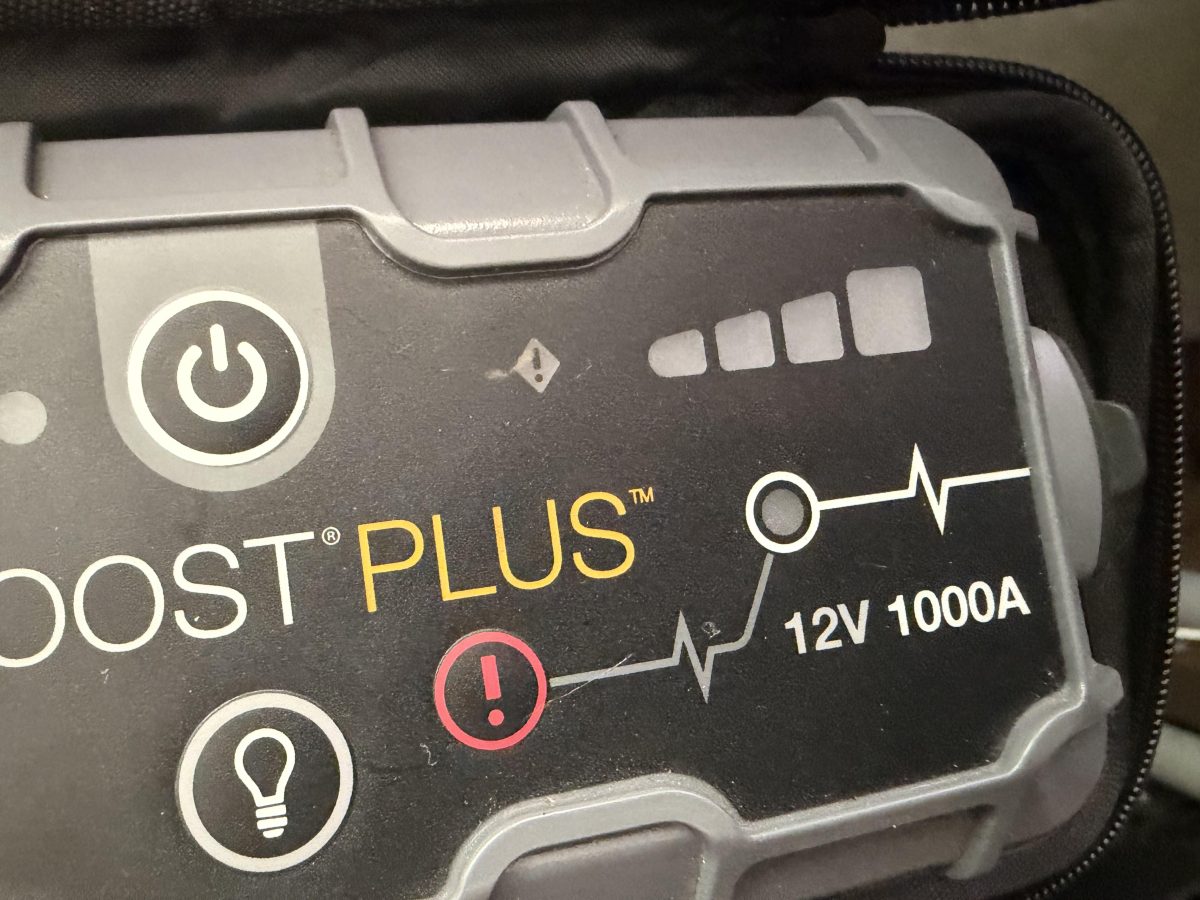
When the 12V is stone dead. NOCO’s user guide: “The GB40 is designed to jump start 12-volt lead-acid batteries down to 2-volts. If your battery is below 2-volts, the Boost LED will be “Off”. This is an indication that the GB40 can not detect a battery.” The fix is Manual Override, which you “push and hold for three (3) seconds.” NOCO’s warning on that button is short: “Disables safety protection and manually forces Boost “On”. Only for use when a battery is too low to be detected.” In that mode, “BOTH THE SPARK PROOF AND REVERSE POLARITY PROTECTION FEATURES ARE DISABLED.” Check red to positive and black to ground twice before you press it.
Check what kind of 12V battery your car has. NOCO’s guide says “The GB40 is for jump starting 12-volt lead-acid batteries only,” and its FAQ is blunt about lithium: jump starting one “could become extremely dangerous.” Many newer Teslas don’t use lead-acid. Tesla’s manual says the jump procedure “differs depending on whether the low voltage battery is lead-acid or lithium-ion,” and tells you how to check: “touch Controls > Software > Additional Vehicle Information.” If yours says lithium-ion, don’t reach for the GB40. Tesla’s manual only says to use “a portable jump starter” and doesn’t name one, and NOCO doesn’t rate any of its packs for lithium. Call us first. Chevrolet says the Bolt “is equipped with an AGM/VRLA 12-volt battery,” so the GB40 is fine there.
Use the jump point in your manual. EVs don’t all put the battery where you can reach it. The Bolt’s jump terminal “is on the driver side of the vehicle, under a bracket and a trim cover.” On a Tesla with the lithium-ion battery, the manual has you remove the maintenance panel and “Pull back the black seal to reveal the positive jump post.” Look yours up before you clamp on to anything. Tesla warns that “Connecting cables to the wrong jump post, touching leads together, etc., can damage Model Y.” For the hybrid side, our step-by-step guide is here: How to Jump Start a Prius.
After the jump
A jump gets the car on. The 12V still needs time to recharge, so leave the car on and let the big battery do it. Plan on 30 to 60 minutes, the same thing we tell hybrid owners, and turn off what you can (heat, AC, seat heaters, audio) so more of that current goes into the 12V. Nissan’s minimum for the Leaf is to “keep in the READY to drive position over 20 minutes to charge the 12-volt battery,” so 30 to 60 gives you some margin.
Then get the 12V tested. Nissan recommends exactly that after a jump, and Toyota says “Once the EV system starts, have the vehicle inspected at your Toyota dealer as soon as possible.” Kia’s manual treats repeat drains as a warning sign, too: if its automatic top-up runs “more than 10 times consecutively,” it stops “because of a potential problem with the auxiliary battery.”
If your car will sit, Chevrolet’s advice for the Bolt is simple: “The best way to store the vehicle for any length of time is to plug in the charge cord and leave it plugged in. The vehicle monitors and maintains the 12-volt battery daily.” If you use a trickle charger, use the right kind. Chevrolet warns the Bolt’s battery “can be damaged by using the incorrect type of trickle charger.”
Frequently asked questions
My EV is completely dead. Is the traction battery gone?
Start with the 12V. A dead 12V can keep the car from turning on, unlocking, or shifting, even with a charged traction battery. Nissan’s Leaf manual says that if the electrical systems won’t turn on, “the 12V battery may be discharged.”
Why won’t my EV shift out of Park?
On many EVs, a discharged 12V locks the car in Park. Toyota, Kia, and Nissan all say so in their manuals. Restore 12V power with a jump box, then try again. If you need a tow first, tell the driver it is locked in Park so they bring a flatbed or dollies.
Can I jump-start another car with my EV?
No. Tesla says its car “cannot be used to jump start another vehicle,” and Nissan says the Leaf “cannot supply enough power to start a gasoline engine.” Use a jump box.
My key fob died. Am I stuck?
No. Use the mechanical key inside the fob to open the driver’s door. Then use your car’s backup start: touch the fob to the power switch on a Leaf or bZ4X, put it in the transmitter pocket on a Bolt, or use the key card on a Tesla.
How do I keep my EV’s 12V from dying while it sits?
Follow your manual. For the Bolt, Chevrolet says to plug it in and leave it plugged in. Turn off Sentry Mode on a Tesla if it doesn’t need to be on, keep the traction battery from running low, and keep the key away from the car.
Related reading
- Why Your Prius or Toyota Hybrid Won’t Start: The 12V Battery Explained
- How to Jump Start a Prius (Step-by-Step, All Generations)
- Why Check Hybrid System Doesn’t Always Mean You Need a Hybrid Battery
- Nissan Leaf Won’t Charge? It Might Be the PDM (Power Delivery Module)
- Plugging In an EV Charger at Home: Why Outlets Melt, and What We Recommend
Sources
Every quote above comes from the manufacturer’s own documents:
- Tesla Model Y Owner’s Manual: Jump Starting, Opening the Hood with No Power, Opening Doors with No Power, Instructions for Transporters, Keys, Sentry Mode
- Nissan Leaf Owner’s Manual
- Chevrolet Bolt EV Owner’s Manual
- Toyota bZ4X Owner’s Manual
- Kia EV6 Owner’s Manual (same text in Kia’s U.S. web manual)
- NOCO: GB40 product page, GB40 how-to, GB40 user guide
Questions about your car? Text us at 503-969-3134 — it’s the fastest way to reach us.
About the author: Travis Decker is the owner of Atomic Auto in Portland, Oregon, and an ASE Master Technician (L1, L3). Atomic Auto specializes in Toyota, hybrid, and EV service.