
Short version: A 2008 Prius died in a friend’s driveway with every warning light on and would not shift out of neutral. Diagnosis found two separate problems: weak modules in the high-voltage battery pack, and a P0AA6 high-voltage isolation leak that step-by-step testing traced to the transaxle — not the battery. Both the battery assembly and the transaxle were replaced.
| Code | What it means | Most common cause we see | Typical fix |
|---|---|---|---|
| P0AA6 | High-voltage isolation fault — the car detected an electrical leak somewhere in the high-voltage circuit | The leak can originate in the battery pack, the inverter, or the transaxle; on this car the battery and inverter tested clean and the leak was in the high-voltage transaxle | Isolate each subsystem to find the leak, then replace the leaking component — here the transaxle (a separate battery fault meant the battery assembly was replaced too) |
What the Driver Noticed
The driver had brought this Prius in previously for a 12-volt battery replacement, which cleared things up at the time. About six weeks before this visit, two new problems appeared: a noticeable lag when accelerating — both from a stop and while already rolling — and a loud, constant humming from the front driver’s side that was present only while the car was moving.
Before they could schedule an appointment, the car died in a friend’s driveway. Every warning light came on at once. Any attempt to shift into drive or reverse resulted in the car sitting in neutral — it simply wouldn’t move. The driver happened to come in shortly after that for work on a different vehicle and mentioned the situation, which is what got this car into the shop.
What We Found
The 12-volt battery had drained and needed a charge before any real diagnostic work could begin. Once the car was powered up, our technician pulled several stored fault codes. Two stood out immediately: one flagging a fault with the high-voltage battery pack, and one flagging a high-voltage isolation fault — meaning the car’s diagnostic system detected an electrical leak somewhere in the high-voltage circuit.
On top of that, a visual and physical inspection turned up a left front wheel bearing making noise and confirmed the car was overdue for routine service.
The Diagnosis
The high-voltage battery fault pointed to specific module data: modules 1 and 2 were reading approximately one volt lower than the other 17 modules in the pack. That kind of imbalance is a clear sign the battery assembly needs to be replaced — individual modules can’t be easily swapped, and a weak cell pair drags down the whole pack under load, which explains the acceleration lag the driver described.
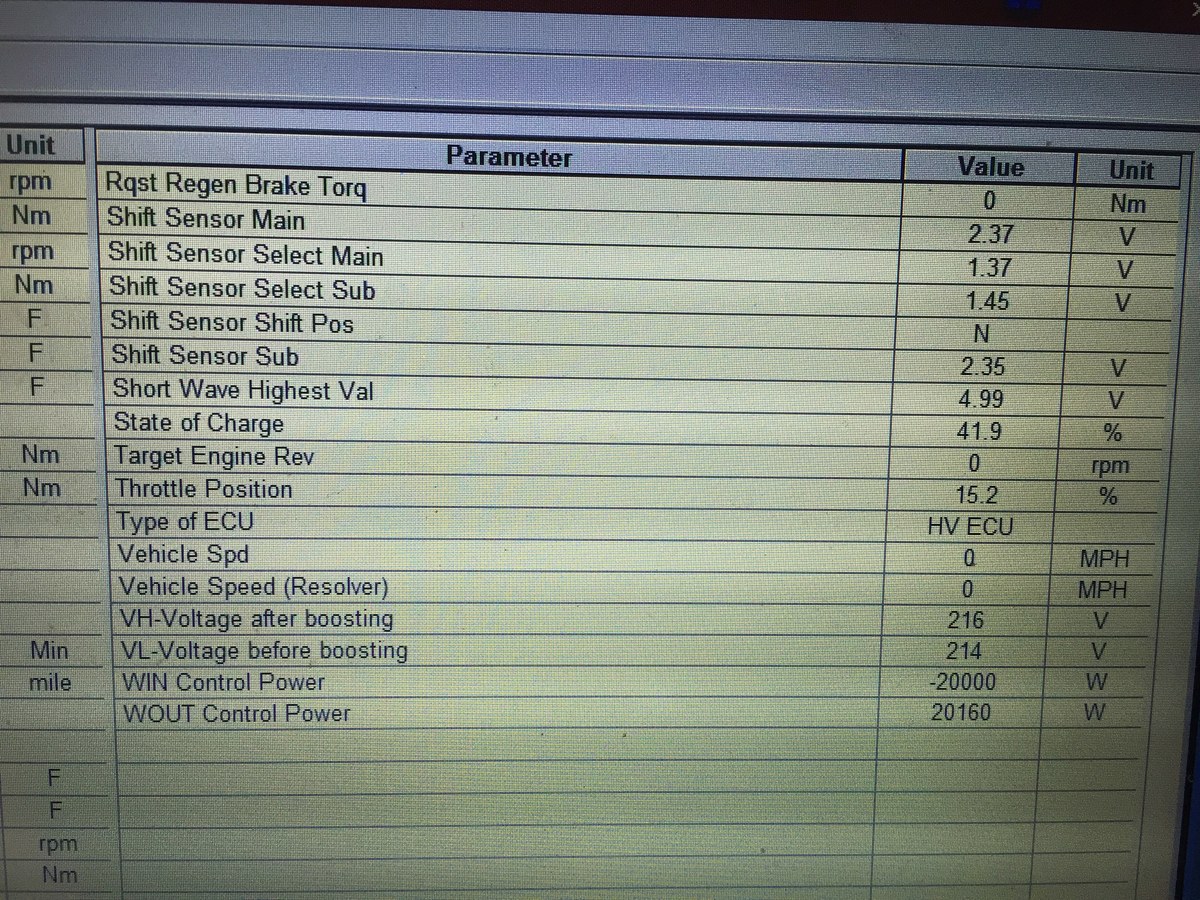
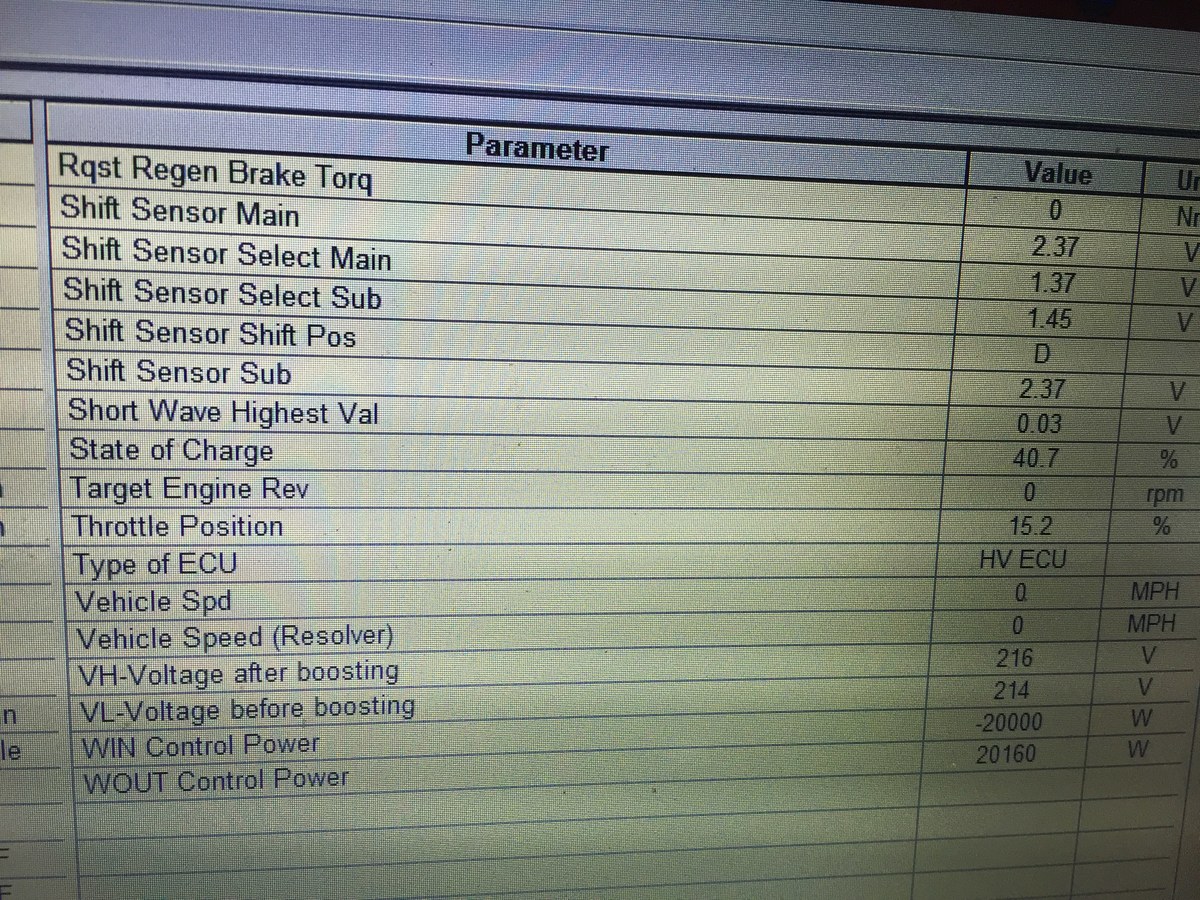
The isolation fault required more careful work to locate. High-voltage isolation faults can originate in three different places: the battery pack itself, the inverter system, or the transmission. Our technician monitored a specific electrical measurement — the high-voltage short wave value — across three separate vehicle states to isolate which system was leaking.
With the key on but the car not yet in ready mode, the reading was nearly 5 volts. That’s normal, and it cleared the battery pack. With the car in ready mode and in neutral, the reading stayed at 5 volts — normal again, which cleared the inverter. When the technician shifted into drive, the value dropped to zero. That’s the tell. Zero means an active high-voltage leak, and in drive, the transmission is the only new system brought into the circuit. The leak was in the high-voltage transaxle.
Two separate systems, two separate problems — the battery pack and the transmission both required replacement.
From the shop floor: On isolation fault codes like P0AA6, the location of the leak matters as much as the code itself. Clearing the code and road-testing without first running a subsystem-by-subsystem isolation check can send a repair in the wrong direction entirely — and on a car with both a battery fault and a transmission fault active at the same time, it’s easy to fix one and miss the other.
The Fix
The driver sourced a used high-voltage battery assembly and a used transaxle and supplied both parts. Our technician removed and replaced the high-voltage transaxle, refilled it with the correct transaxle fluid, and topped off the inverter coolant system. The high-voltage battery assembly was removed and replaced as well.
The left front wheel bearing noise and the overdue service items were noted for the driver to address separately.
What This Means for Your Car
On a Prius this age, the high-voltage battery and the transmission are the two most expensive systems on the car. Having both fail around the same time isn’t common, but it’s not unheard of either — especially when a vehicle has accumulated significant mileage and the battery has been showing subtle performance issues for a while.
The acceleration lag that showed up weeks before the shutdown was almost certainly the weakened battery modules struggling to deliver full power. The humming from the front driver’s side was the transmission. By the time the car died completely, both problems had progressed to the point of leaving the car unable to drive.
The isolation test that identified the transmission as the leak source is worth understanding: a high-voltage isolation fault code alone doesn’t tell you where the leak is. It takes a step-by-step process — testing each subsystem individually — to pin it down. In this case, the battery pack tested clean. Without that methodology, a repair based only on the fault code could have missed the transmission entirely.
Read the full guide: Toyota Prius & Hybrid P0AA6 Code Explained — what P0AA6 means, the common causes, and why it is often not the battery.
Frequently Asked Questions
What does it mean when a Prius shows a high-voltage isolation fault?
It means the car has detected an electrical leak somewhere in the high-voltage circuit. The fault code itself doesn’t tell you where — it could be the battery pack, the inverter system, or the transmission. Pinpointing the source requires testing each subsystem separately while monitoring the car’s high-voltage electrical readings in different operating states.
Does a high-voltage isolation fault always mean the hybrid battery is bad?
Not necessarily. In this case, the battery pack tested clean for the isolation fault — the leak was actually inside the transmission. A separate battery fault code identified the weak modules. The two codes pointed to two different problems, and treating only one would have left the car undrivable.
My Prius was lagging during acceleration before it died. Was that related?
Most likely yes. When one or more modules in the high-voltage battery pack weaken, the pack can’t deliver full power on demand. That shows up as hesitation or lag when accelerating, both from a stop and at speed. It often appears weeks before the car reaches the point of a full shutdown.
What causes a humming noise from the front of a Prius while driving?
A constant hum that appears only while the car is moving and comes from the front driver’s side is usually either a wheel bearing or the transmission. In this case, the inspection found both — a high-voltage transaxle fault and a separate wheel bearing noise on the left front. They’re different components and would be repaired independently.
Can a Prius completely lose the ability to shift into drive or reverse?
Yes. When the car’s systems detect a serious fault in the high-voltage circuit — like the isolation leak confirmed here — the car will go into a protective mode that prevents it from being driven. The shifter will appear to engage, but the car stays in neutral. It’s a built-in safety response, not a transmission failure in the traditional sense.
Is a used high-voltage battery or transaxle a reasonable repair option for a 2008 Prius?
It depends on the condition and mileage of the used parts, but it’s a common approach for a vehicle this age when new or remanufactured parts would cost more than the car is worth. The driver in this case sourced both components and supplied them for installation. The shop’s role was confirming the diagnosis, performing the work correctly, and ensuring the systems were refilled and functioning after the swap.
Scan Reports from This Visit
Photos from This Visit
Related reading
- Toyota Hybrid Trouble Codes
- Toyota Prius & Hybrid P0AA6 Code Explained
- 2007 Prius P0AA6 voltage leak after reconditioned battery failed
- 2009 Highlander Hybrid P0AA6: How a Leaking Sunroof Almost Cost a Hybrid Battery
- Do I actually need a hybrid battery replacement?
Need to get your car in for us to check it out? Book online or text us at 503-969-3134.
Questions about your car? Text us at 503-969-3134 — it’s the fastest way to reach us.
About the author: Travis Decker is the owner of Atomic Auto in Portland, Oregon, and an ASE Master Technician (L1, L3). Atomic Auto specializes in Toyota, hybrid, and EV service.