

Prius P1121 Code: The Thermos Bottle in Your Gen 2 and the Valve That Runs It
If you drive a second-generation Prius, there’s a thermos bottle near your left front bumper. We’re not being cute. That’s how Toyota describes the coolant heat storage tank: its construction “is the same as the household Thermos bottle.” P1121 is the code your Prius sets when the valve that runs that thermos stops doing its job.
First, how the system works. Once you know that, P1121 makes a lot more sense.
How the coolant heat storage system works
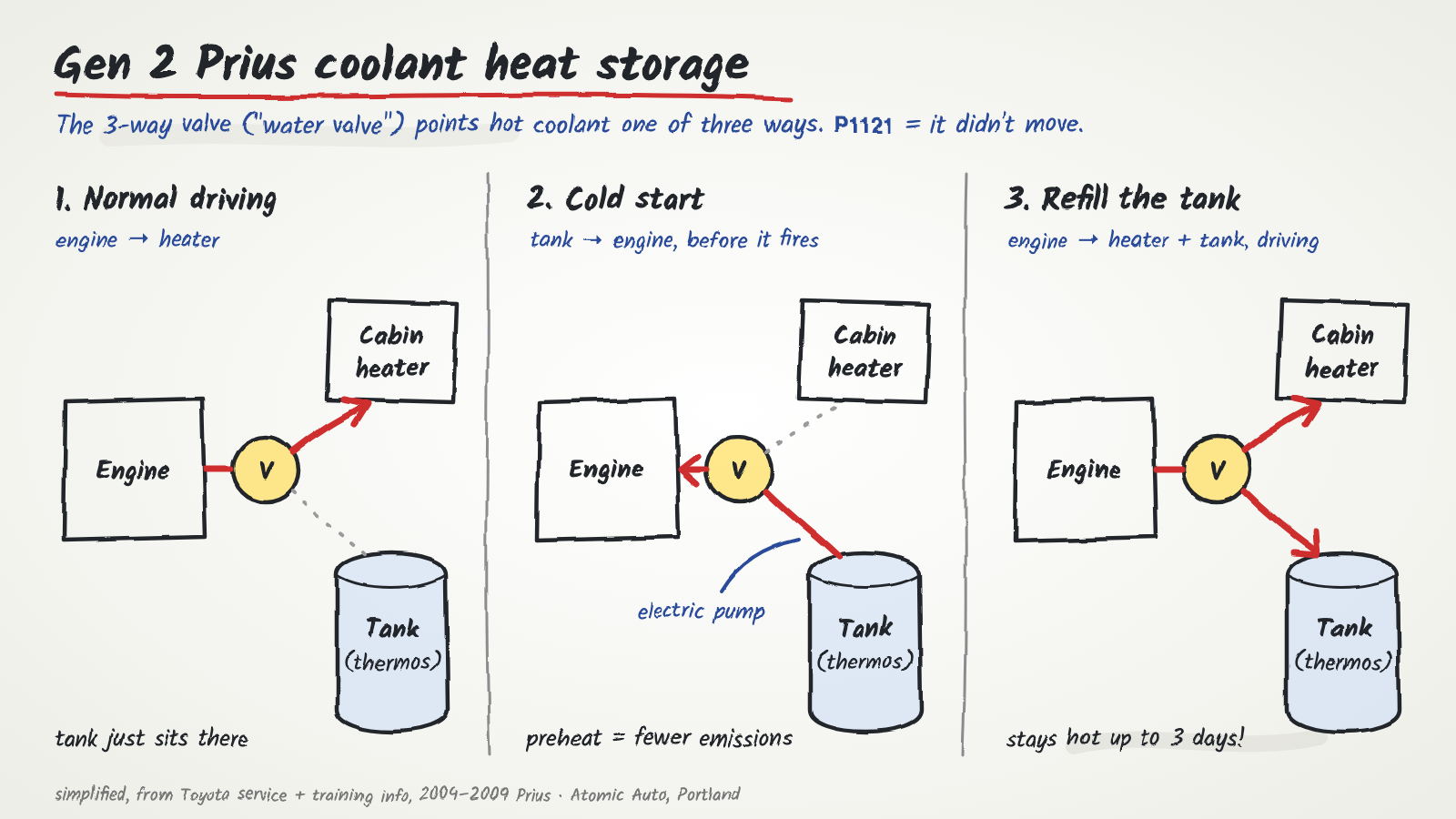
While you drive, the Gen 2 Prius saves some of its hot engine coolant in an insulated stainless steel tank. The tank holds about 3 liters. Toyota says the coolant stays hot in there for up to three days.
The next time you start the car cold, an electric pump pushes that hot coolant into the engine before the engine runs. Toyota calls this preheat, and it takes a few seconds. A warm engine needs less fuel on a cold start, and that cuts emissions. That’s what the system is for.
The traffic cop in the middle is a valve. Toyota calls it the water valve. Our techs call it the three-way valve, because it has three jobs:
- Normal driving: coolant goes from the engine to the cabin heater.
- Preheat: coolant goes from the tank to the engine.
- Refilling the tank: while the engine runs, coolant goes from the engine to the heater and to the tank.
One more thing owners ask us about. About 5 hours after you shut the car off, the pump may run on its own while the computer checks that the tank is still holding heat. If you’ve heard a motor running under the hood of a parked Prius, Toyota says that’s normal.
Toyota dropped the tank when it redesigned the Prius for 2010 and used an exhaust heat recirculation system instead. P1121 only shows up on the Gen 2 Prius, because it’s the only Prius with the coolant heat storage system.
What P1121 means
Toyota’s name for it is “Coolant Flow Control Valve Position Sensor Circuit Stuck.” Our notes often spell it “Stick,” like this:
P1121- Coolant Flow Control Valve Position Sensor Circuit Stick
In plain terms: the engine computer told the valve to move, and the valve’s position sensor says it didn’t. Or it moved too slowly. Toyota’s repair manual gives three places to look: the valve, the cooling system, and the engine computer.
P1121 often has a partner, P1116. That one sets when the tank’s temperature sensor doesn’t see the change it expects while the tank is refilling.
Usually it’s the valve
Most of the time, the valve itself has failed. A typical note from one of our techs is short:
P1116&P1121are set due to a failed three-way valve. Recommend replace valve.
And clearing the code won’t fix it. On that same car, we cleared the codes after fixing a different problem, and the two were back on the test drive:
CEL is back on,
P1116&P1121returned immediately.
But “usually” isn’t “always.” Toyota lists three places to look, and we’ve found the problem in all three. That’s why we test before we sell anyone a valve.
Three cars, three different answers
The home repair that leaked
This 2007 Prius came in with slow heat. The owner had already done the obvious repair: a new water pump and a new three-way valve, put in and bled at home. The old pump’s noise was gone. The code and the slow heat weren’t.
Our scan showed P1121 with two more heat storage codes, P1122 and P1151. Then our tech opened the radiator cap and found almost nothing there:
I did find that the coolant level is very low. There is no coolant in the overflow tank and when I opened the radiator cap there is no coolant I can see either. This would explain the lack of heat. The 3 way valve itself is leaking from the seam.
So the new valve was leaking. We put in another valve, filled the coolant, and drove it. No codes came back.
Then the heater fan wouldn’t run. Behind the cabin filter: a rodent nest. That’s its own story, and we’ve written it up in mice in a Prius.
The valve was fine. The hoses weren’t.
This 2007 Prius showed up overdue for service with a long list of codes, P1121 and P1116 among them. The coolant was full. So our tech used the scan tool to move the valve end to end and watched the coolant temperature while it moved. Nothing changed. Then the tech looked underneath:
I inspected the underside of the vehicle and found that the hoses to the auxiliary water pump and coolant heat storage tank have been switched.
Somebody had been in there before us and put two hoses back on the wrong fittings. The valve could move all it wanted, and the hot coolant still went the wrong way. We put the hoses where they belong, purged the air, and the system worked. A new valve would have cost money and fixed nothing.
When it’s not the valve or the plumbing
This Gen 2 owner picked up their Prius from us after a valve repair. The light was off on the way home. By that night it was back, and they needed it off to pass DEQ.
We did the simple things first: topped off the coolant, bled the air out on the freeway, and rechecked. It looked fixed. Then:
Check engine light comes on after parking the vehicle and driving it again.
So our tech connected Techstream, Toyota’s scan tool, and commanded the valve directly. It didn’t respond. Next came the wiring. That meant pulling the engine harness back through the firewall to check all five wires to the valve. They were fine. Power and grounds to the computer were fine too. That left one thing:
It appears the ECU is not sending the signal.
We replaced the engine computer and programmed it to the car. This time the valve moved when Techstream told it to, and no codes came back.
Most P1121 cars don’t go this deep. But when a code comes right back after the part was replaced, we keep testing. We don’t buy another part and hope.
What this means for you
If your Gen 2 Prius has P1121, the three-way valve is the most likely answer. But nobody has to guess. With the right scan tool, a shop can command the valve and watch the coolant temperature. That test, plus a look at the coolant level and the hoses, tells you whether the valve is really the problem.
If the code came back after someone already replaced the valve, have the coolant level checked and look for leaks at the new valve. Then ask whether anyone has checked the wiring and the engine computer. It’s the same test-first order we use on other warning lights. Here’s how we diagnose Toyota hybrid problems.
Shopping for a Gen 2 Prius? Read what to know before buying a used Prius, and get a pre-purchase inspection before you sign. If C2318 or B1271 shows up on your scan too, our page on what C1241 shows up alongside covers those. Every code we’ve written up is on our Toyota hybrid and EV trouble codes page.
Frequently asked questions
Does P1121 always mean I need a new three-way valve?
Usually, but not always. We’ve also found a leaking valve that let the coolant run low, coolant hoses on the wrong fittings, and an engine computer that wasn’t sending the signal. Test before you replace.
Why do I hear a motor running under the hood after I park my Prius?
On a Gen 2 Prius, Toyota says the coolant heat storage pump can run about 5 hours after you shut the car off. The computer is checking that the tank still holds heat. Toyota calls that sound normal.
Does the 2010 Prius have a coolant heat storage tank?
No. When Toyota redesigned the Prius for 2010, it replaced the tank with an exhaust heat recirculation system. P1121 belongs to the Gen 2 cars.
Questions about your car? Text us at 503-969-3134 - it’s the fastest way to reach us.
About the author: Travis Decker is the owner of Atomic Auto in Portland, Oregon, and an ASE Master Technician (L1, L3). Atomic Auto specializes in Toyota, hybrid, and EV service.
General information from the cars that come through our bays. Yours is its own case, and we would rather test it than guess.
Text us, or book a slot.
A text with a photo of the dash gets you an answer fastest. Booking online holds a day and a time.